Who is Sadashiva
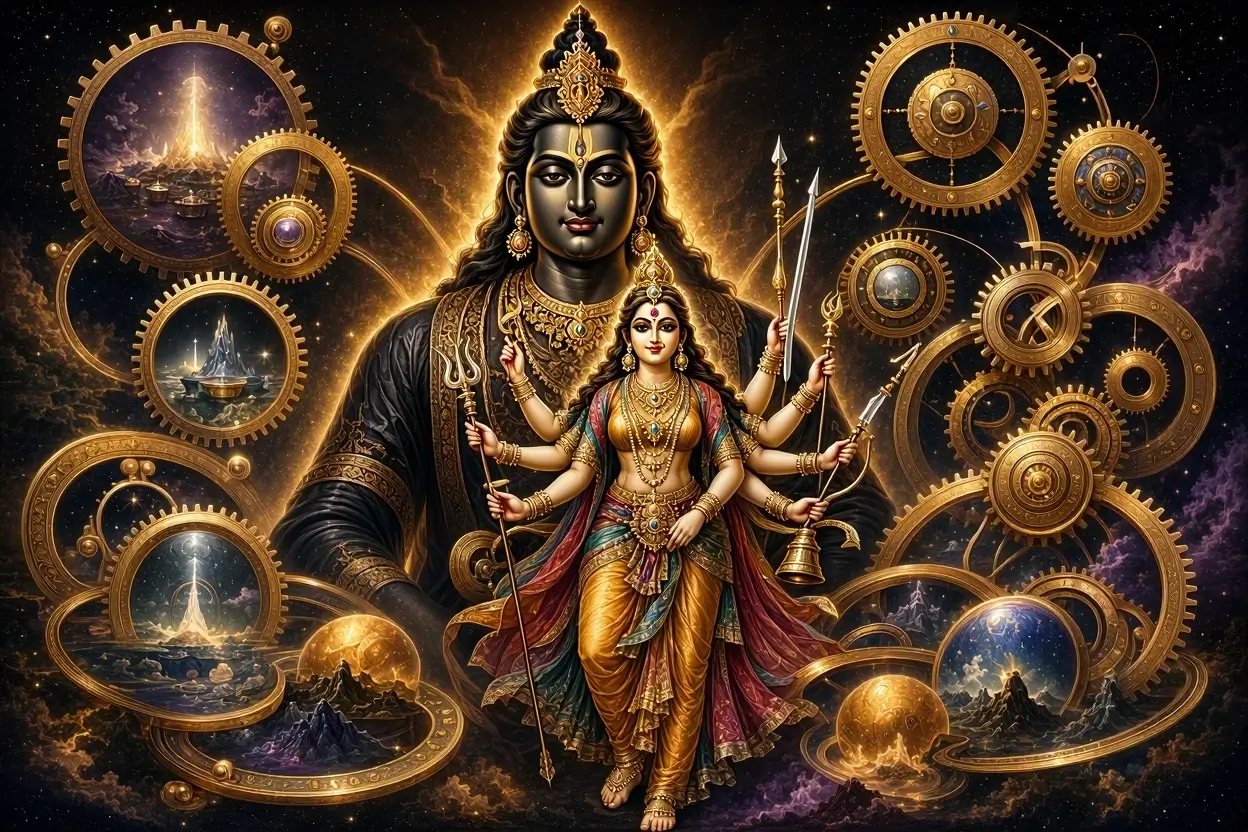
Within Vedic cosmology and Puranic literature, the concept of Sadashiva represents a foundational metaphysical reality. Frequently examined in the structural chapters of the Shiv Purana, Sadashiva is depicted as the unmanifest Supreme Brahman/Brahm (Kaal) who takes a manifest, physical form to oversee cosmic cycles and administration. By exploring verified text traditions, including the authoritative Gita Press Gorakhpur volumes, spiritual researchers can analyze the scriptural lineages, relationship frameworks, and timelines that define this central divinity. Below, we break down his cosmic attributes and actions during the universal creation process.
Who is Sadashiva?
Sadashiva is the father of Shiva, Brahma and Vishnu. In the Puranas, the name Sadashiva is mentioned, especially in Shiva Purana. In the Rudrasamhita chapter of Shiva Purana, all the knowledge has been given about how Lord Sadashiva created Goddess Durga and then gave rise to their sons Brahma, Vishnu and Shiva. Sadashiva is also addressed in some Puranas as Mahabrahma, Mahavishnu and Mahashiva. He is also called Brahm or Kaal.
The images below are from Shiva Purana, Rudrasamhita which describe Sadashiva and his actions at the time of creation.
Shiv Purana Rudra Samhita Adhyay 6 - Pages 119-123 - Relevant Summary - Original Verses and Details
1. The Manifestation of Sadashiva & Goddess Ambika (Durga)
Original Hindi Text (Image 1 & 2):
उस समय एकाकी रहकर स्वेच्छानुसार विहार करनेवाले उन सदाशिवने अपने विग्रहसे स्वयं ही एक स्वरूपभूता शक्तिकी सृष्टिकी... [Please refer to the referenced web documents for the complete original Hindi verse regarding the manifestation of Parashakti and Goddess Ambika with eight arms].
English Translation & Analysis:
Lord Sadashiva willed to manifest his inseparable sovereign energy, Parashakti or Ambika, defined as Pradhana, Prakriti, Maya, and the mother of the deities, possessing eight arms.
2. The Creation and Naming of Lord Vishnu
Original Hindi Text (Image 3 & 4):
एक समय उस आनन्दवनमें रमण करते हुए शिवा और शिवके मनमें यह इच्छा हुई... [Please refer to the referenced web documents for the complete original Hindi verse detailing the creation of Lord Vishnu from the left limb].
English Translation & Analysis:
Desiring an entity to manage cosmic administration, Lord Sadashiva applied nectar to his left limb, manifesting a peaceful, beautiful being named Vishṇu for his all-pervasive nature.
3. The Creation of Lord Brahma from the Right Limb
Original Hindi Text (Image 5):
तत्पश्चात् कल्याणकारी परमेश्वर साम्ब सदाशिवने पूर्ववत् प्रयत्न करके मुझे अपने दाहिने अंगसे उत्पन्न किया... [Please refer to the referenced web documents for the complete original Hindi verse where Brahma describes his birth from the right limb and placement in Vishnu's lotus].
English Translation & Analysis:
Lord Brahma (Hiranyagarbha) was subsequently generated from Sadashiva's right limb, placed in Vishnu's umbilical lotus with four faces and a red physical form.


Shiv Purana - Rudra Samhita Chapter 6 | English - Detalied Account
(Description of the nature of Mahapralaya and the origin of Vishnu)
Brahma said:-
16-18. A form that goes everywhere, that has all forms, that sees all, that is the cause of all, that should be respected by all, that is at the beginning of all, that bestows everything, and that sanctifies everything should be created ( So it wished) and hence created that form of Isvara of pure nature. The original Being without a second, with neither beginning nor end, that illuminates everything, that is in the form of Cit (pure knowledge) , that which is termed Supreme Brahm, the all-pervasive and undecaying, vanished, The manifest form of the formless Being is Sadashiva. Scholars of the ancient and succeeding ages have sung of it as lshvara.
Creation of Goddess Durga by Sadashiva
19. God Sadashiva though alone, then created the physical form Shakti from his body. This Shakti did not affect his body in any way.
20. This Shakti is called by various names. Pradhana, Prakrti, Maya, Gunavati, Maya. The mother of Buddhi Tattva (The cosmic Intelligence) , Vikrtivarjita (without modification ).
21. That Shakti is Ambika, Prakrti and the goddess of all. She is the prime cause and the mother of the three deities.
22. She has eight arms. Her face wears a peculiar splendour, the splendour of a thousand moons. Thousands of stars perpetually sparkle round her face.
23. She is bedecked in various ornaments. She has various weapons. She is capable of various movements. Her eyes beam like a full blown lotus.
24. She has a brilliance which could hardly be conceived. She is the generating cause of all. She sprang up singly as Maya. In her union she manifested in various forms.
Sadashiva is also known as Brahm or Kaal
27. That Brahm form of Kaal together with Shakti, simultaneouly created the holy centre called Shivaloka.
28. The same is called Kashi, the excellent holy centre. It is the seat of salvation shining over and above everything.
29. The holy centre is of the nature of extreme Bliss in as much as the primordial lovers, supremely Blissful, made that beautiful holy centre their perpetual abode.
30. O sage, that holy centre is never, even at the time of Great Dissolution, free from Shiv and Shivaa (Shakti). Hence it is called Avimukta.
31. Since the holy centre is the cause of Bliss, the Pinaka-bearing lord (Shiva) called it "the blissful forest" and later "Avimukta".
Creation of Lord Vishnu by Sadashiva
33-38. Shiva thought within Himself like this- "Another being shall be created by me. Let him create everything, protect it and in the end let him dissolve it with my blessing. Having entrusted everything to him we two, remaming in Kashi shall roam as we please keeping only the prerogative of conferring salvation. We can stay happily in this blissful forest being free from worries (of creation). With the consent of Shiva the supreme lord spread the liquorine essence of nectar on His left side, on the tenth limb. Thereupon a person came into being who was the most charming one in the three worlds, who was calm with Sattva Guna being prominent, and who appeared to be the ocean of immeasurable majesty.
39. O sage, he was endowed with patience. There was no one comparable to him. He had the lustre of sapphire. He was glorious with his excellent eyes shining like a lotus.
40. He was having a golden form and features. He wore two excellent silk garments of golden colour. His arms were brawny and brilliant. He was indefatigable.
41. He bowed to Shiva Paramesvara and said - "O lord give me names and assign me my task."
42. On hearing it Lord Shiva laughed. With words thunder-like in resonance, Lord Shiva addressed the person thus. Shiva said :-
43. "You will be famous as Vishnu by name as you are all-pervasive. You will have many other names conferring happiness on devotees.
Shiv Purana Rudra Samhita Chapter 7 - English - Page 123
Creation of Brahma by Sadashiva
4. Exerting himself as before, Sadashiva, the great lord, with Parvati as his better half created me from His right limb.
As Brahma is narrating the above account, he is therefore talking about his own creation by Lord Sadashiva.
For a complete, unabridged chapter layout of these creation dialogues, read our full guide to the Birth of Brahma, Vishnu, and Shiv in the Shiva Purana.
Shiv Puran | Rudra Samhita | Video
What is the age of Sadashiva?
An evaluation of cosmic timelines across comparative Puranic layers reveals a structural framework where even high-level cosmic administrators like Sadashiva are assigned finite, cyclical lifespans thus proving he is not eternal. It is already known that Age of Shiva is finite who is the son of Sadashiva. Calculation of age of Sadashiva therefore is done by taking the age of Shiva as a base unit. When 70,000 Shiva die, one Sadashiva dies. Therefore age of Sadashiva is 70,000 times the age of Shiva.
Conclusion: The Cosmic Role of Sadashiva
In conclusion, analyzing the structural narratives of the Shiv Purana provides critical clarity on the identity and creative actions of Sadashiva. It also clarifies Sadashiv (Brahm) being the father of Brahma, Vishnu and Shiva. Characterized as the manifest form of the Supreme Brahm (Kaal), the text outlines how this central figure establishes cosmic frameworks alongside Prakriti Devi (Durga) to govern material creation. For spiritual researchers evaluating verified Gita Press Gorakhpur source texts, understanding these precise relationship lineages is essential for mapping out the comprehensive hierarchy of ancient Vedic cosmology.
Interactive Cosmic Calculator
Mahakalp Chronometer
Full 10-Tier Vedic Cosmic EngineContinue Your Scriptural Research
To explore how these cosmic governance frameworks connect across other major Mahapuranas, visit our detailed research directories:
