Origin of Shiv Ling: True Symbolism from the Shiva Purana
The Origin and Symbolism of the Shiv Ling: Insights from the Shiva Purana
The Shiv Ling stands as one of the most profound and widely revered symbols in Hinduism, representing the formless, infinite nature of the Divine. Yet, its origins and deep spiritual meanings are often subject to varying interpretations. To truly understand its significance, one must look directly to the ancient verses of the Shiva Purana.
This comprehensive guide breaks down the textual evidence from the sacred chronicles, exploring the two primary scriptural accounts of how the Shiv Ling manifested and why it is worshipped today:
- The Cosmic Pillar of Fire: How a limitless, radiant pillar emerged to settle an apocalyptic dispute between Lord Brahma and Lord Vishnu (Vidhweshwar Samhita).
- The Union of Cosmic Principles: The sacred forest narrative detailing the physical manifestation of the Shiv Ling and its eternal stabilization by Goddess Parvati (KotiRudra Samhita).
By diving past modern misconceptions and examining the original Sanskrit narratives, we uncover a deeply symbolic framework where the origin of Shiv Ling is uncovered from the Shiv Purana.
Origin of Shiv Ling
The Battle of Egos: Brahma vs. Vishnu
According to the Vidhweshwar Samhita (Chapters 6–8), the origin of the Shiv Ling begins with a massive cosmic conflict. The universe’s two great deities - Lord Brahma, the Creator, and Lord Vishnu, the Preserver - became locked in a fierce war of words over who was the ultimate supreme ruler of the cosmos.
As their egos clashed, the argument quickly escalated into a violent, apocalyptic battlefield. Mounted on their respective vehicles (the Swan and the Garuda), the two deities unleashed their most catastrophic cosmic weapons:
- Vishnu discharged the unbearable Mahesvara weapon.
- Brahma retaliated by aiming the devastating Pasupata weapon directly at Vishnu’s chest.
The fiery clash of these two ultimate forces began to incinerate the three worlds, threatening an untimely, total dissolution of the entire universe.
The Manifestation of the Infinite Column
To prevent total destruction, the formless essence of Lord Shiva intervened. He assumed a terrifying yet magnificent form, manifesting directly between the warring deities as a limitless column of fire (the Jyotirlinga). Instantly, the column swallowed both of the apocalyptic weapons, neutralising their deadly flames.
Stunned by this incomprehensible phenomenon, Brahma and Vishnu called a truce to investigate the mysterious pillar.
- Brahma flew upwards on his swan to find the top end.
- Vishnu dove downwards into the depths to find the bottom.
The Falsehood and Shiva's Judgment
After eons of searching, neither could find the boundaries of the infinite pillar. Exhausted, Vishnu returned and honestly admitted his inability to find the bottom. Brahma, however, chose to practice trickery. He falsely claimed he had reached the top, using a falling Ketaki flower as a fraudulent witness to back up his claim.
Recognising the deceit, Lord Shiva burst forth from the pillar of fire in a visible form to deliver judgment. To humble the creator's pride, Shiva manifested the fierce deity Bhairava, who instantly cut off Brahma's fifth head—the very head that had spoken the lie.
Terrified and humbled, both deities bowed in deep reverence. Shiva then revealed that this cosmic, radiant pillar was the Shiv Ling, commanding them - and the universe - to worship it from that moment forward as the ultimate symbol of the Supreme Reality.
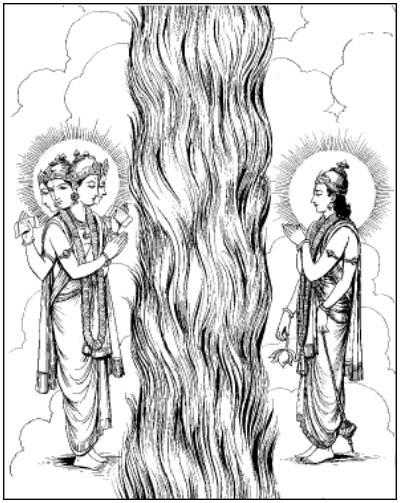
This is how the worship of the Shiv Ling started.
Shiv Puran Vidhweshwar Samhita gives a detalied account of this event which is given below. Futher in Shiv Puran God Sadashiv explained what exactly Shiv Ling was. That knowledge can be read in a section further below.
Shiv Puran, Vidhweshwar Samhita Page 11
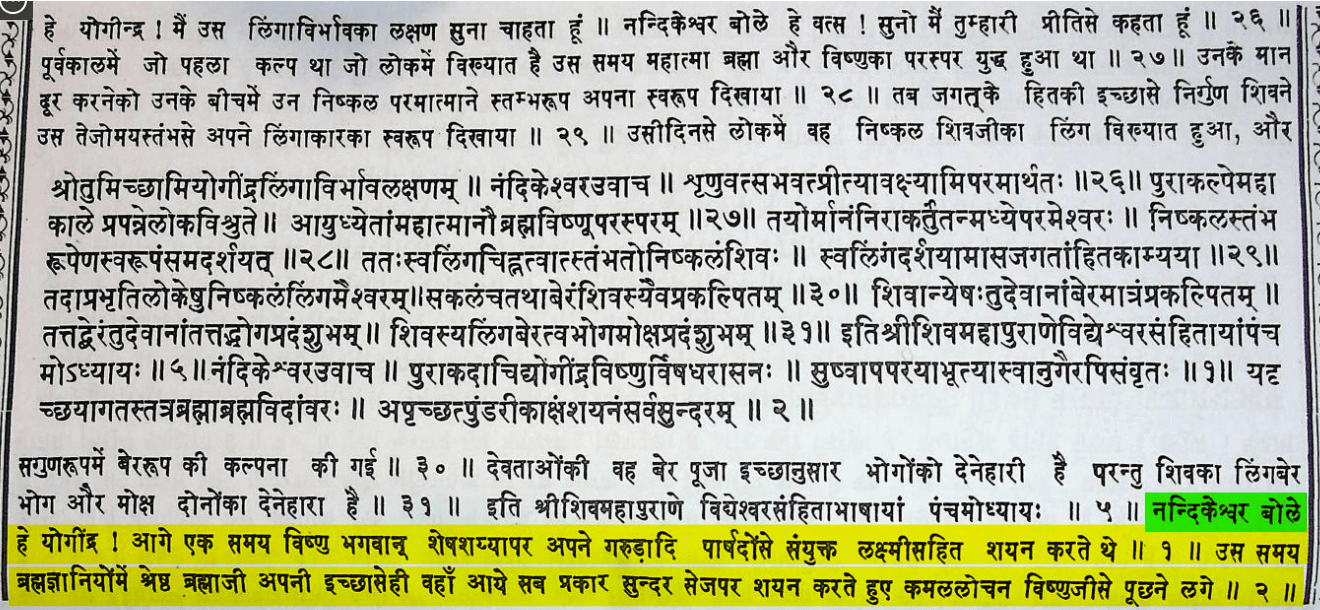
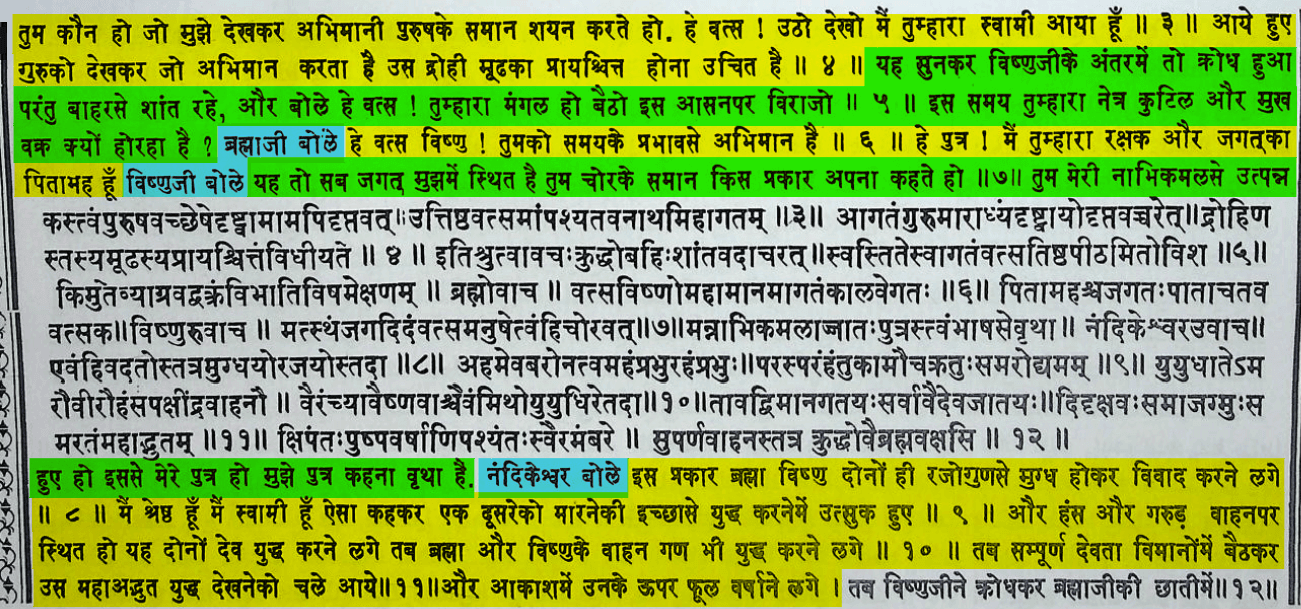
Shiv Puran, Vidhweshwar Samhita, Adhyay 6 onwards
CHAPTER SIX
(The journey to Kailasa of the Deuas terrified by the use of the Pasupata weapon in the fight between Brahma and Vishnu who vied with each other maintaining that each of them is the Lord himself)
Nandikeshwara said:-
1. Once, long ago, O foremost among Yogis, Vishnu was having his nap on his serpent-couch. He was surrounded by the goddess of fortune and his attendants.
2. Brahma, the foremost among the Vedic scholars chanced to come there. He asked the lotus-eyed handsome Vishnu who was lying there.
3. Who are you lying here like a haughty person even after seeing me? Get up, O dear, and see me who am your lord. I have come here.
4. Expiatory rites are ordained for that spiteful wretch who behaves like a haughty fool at the visit of an honourable elderly person.
5. On hearing these words VIshnu was angry. But assuming a calm exterior he said-"O dear, Hail thee. Welcome. Please sit on this couch. How is it that your face is agitated and your eyes look curious?
Brahma said:-
6. Dear Vishnu, know me to have come with the speed of the Time. I am to be honoured greatly. O dear one, I am the protector of the world, Grandfather, your protector as well.
Vishnu said:-
7. O dear one, the whole universe is situated within me but your way of thinking is like that of a thief. You are born of the lotus sprung from my navel-region. You are my son. Your words are futile therefore.
Nandikeshvara said:-
8-9. Arguing with each other like this, saying that each is better than the other and claiming to be the lord, they got ready to fight, like two foolish goats, desirous of killing each other.
10. The two heroic deities, seated on their respective vehicles-the Swan and the Garuda, fought together. The attendants of Brahma and Vishnu also came into clash.
11. In the meantime the different groups of Devas moving about in aerial chariots came there to witness the wonderful fight.
12-18. Witnessing from the heaven they scattered flowers everywhere. The Garuda-vehicled deity (Vishnu) became infuriated and discharged unbearable arrows and many kinds of weapons on the chest of Brahma. The infuriated Brahma also hurled many arrows of fiery fury and different kinds of weapons on Vishnu. The Devas commented on this wondrous fight and were agitated much, Vishnu in his great fury and mental agitation breathed hard and discharged the Mahesvara weapon over Brahma. Annoyed at this, Brahma aimed the terrible Pasupata weapon at the chest of Vishnu. The weapon rising high in the sky blazing like ten thousand suns, with thousands of terrible pointed spikes roared awfully like a gust of wind. These two weapons of Brahma and Vishnu thus faced each other in a terrible clash
.........
CHAPTER SEVEN
(Shiv manifesting himself as a column of fire in the battlefield)
10-11. The flames emitted by the two weapons of Brahma and Vishnu burned the three worlds. On seeing this imminent untimely dissolution the bodiless form of Shiv assumed the terrific form of a huge column of fire in their midst.
12. The two weapons of fiery flame potential enough to destroy the entire world fell into the huge column of fire that manifested itself there instantaneously.
13. Seeing that auspicious wonderful phenomenon assuaging the weapons they asked each other "What is this wonderful form ?"
14. "What is this column of fire that has risen up ? It is beyond the range of senses. We have to find out its top and bottom."
.........
26. (Returning to the original place) on seeing Vishnu there, utterly exhausted and lacking pleasure, Brahma danced with joy. Vishnu, in the manner of a eunuch admitting his inability (to a woman ), told him the truth (that he could not see the bottom). But Brahma told Vishnu like this.
27-28. "O Hari, the top of this column has been seen by me. This Ketaki flower is my witness." The Ketaka flower repeated the falsehood endorsing the words of Brahma in his presence. Hari, taking it to be true, made obeisance to Brahma. He worshipped Brahma with all the sixteen means of service and homage.
29. The Lord taking up a visible form in order to chastise Brahma who practised trickery, came out of the column of fire. On seeing the lord, Vishnu stood up and with his hands shaking with fear caught hold of the lord's feet.
..........
CHAPTER EIGHT
(Shiv's forgiveness of Brahma)
Nandikeshvara said:-
1. Mahadeva then created a wonderful person, Bhairava, from the middle of his brows to quell the pride of Brahma.
2. This Bhairava knelt before the lord in the battle-field and said-"O lord, what shall I do ? Please give me your directives quickly. "
3. "Dear, here is Brahma, the first deity of the universe. Worship him with your sharp-pointed quick-moving sword."
4. With one of his hands he caught hold of the tuft of Brahma's fifth head that was guilty of haughtily uttering a falsehood, and with the hands he furiously shook his sword in order to cut it off.
...........
The Core Definition: What is the Shiv Ling?
In the Vidhweshwar Samhita (Chapter 9) of the Shiva Purana, the true spiritual and cosmic nature of the Shiv Ling is explained directly by the Divine. Rather than a simple ritual object, it is defined as a profound physical representation of the cosmic forces that create and sustain the universe.
The scripture breaks down the anatomy of the Shiv Ling into two inseparable components that mirror the fundamental duality of existence:
- The Phallic Emblem (Lingam): Represents Lord Shiva.
- The Pedestal (Yoni/Pudenda): Represents Goddess Parvati, nature (Prakriti).
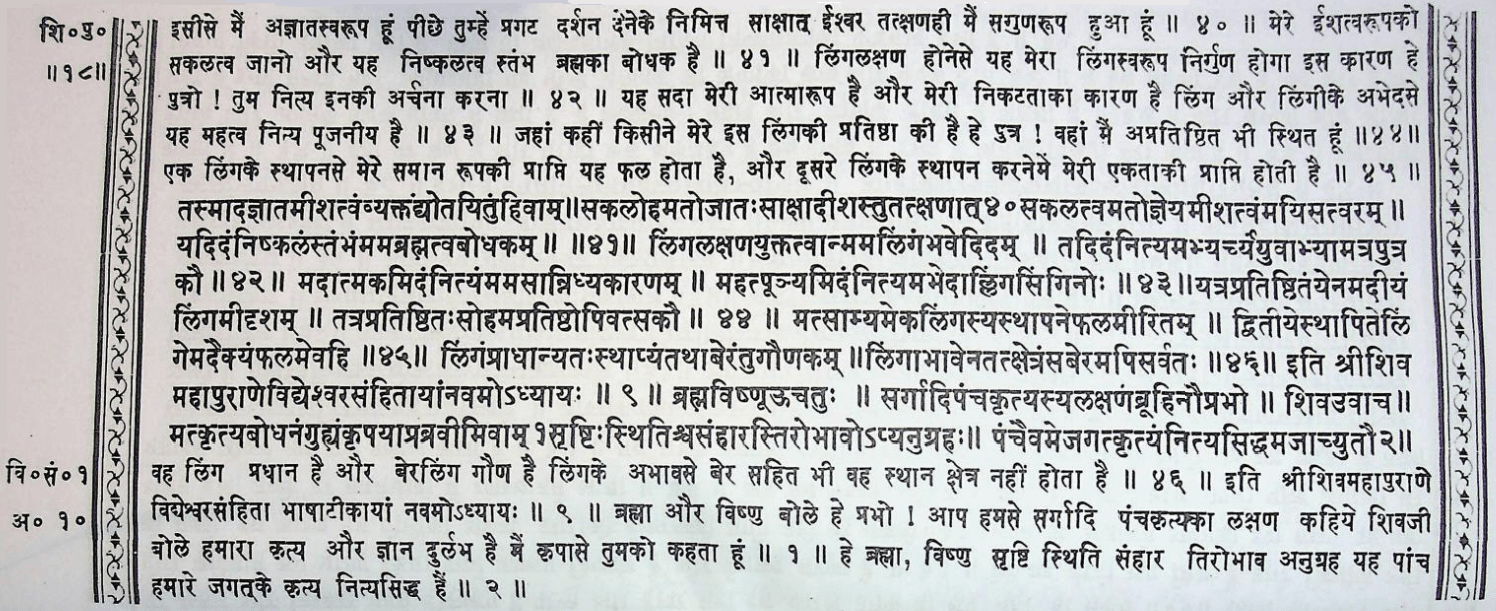
In Shiv Puran, God Sadashiv explains to both Brahma and Shiv that the whole structure of Shiv Ling represents the phallus adjoined to the pudenda (female genitalia, vagina).

Shiv Puran - Vidhweshwar Samhita, Adhyay 9, Page 18, Verses 41 - 43
Khemdas Shri Krishan Das Publication
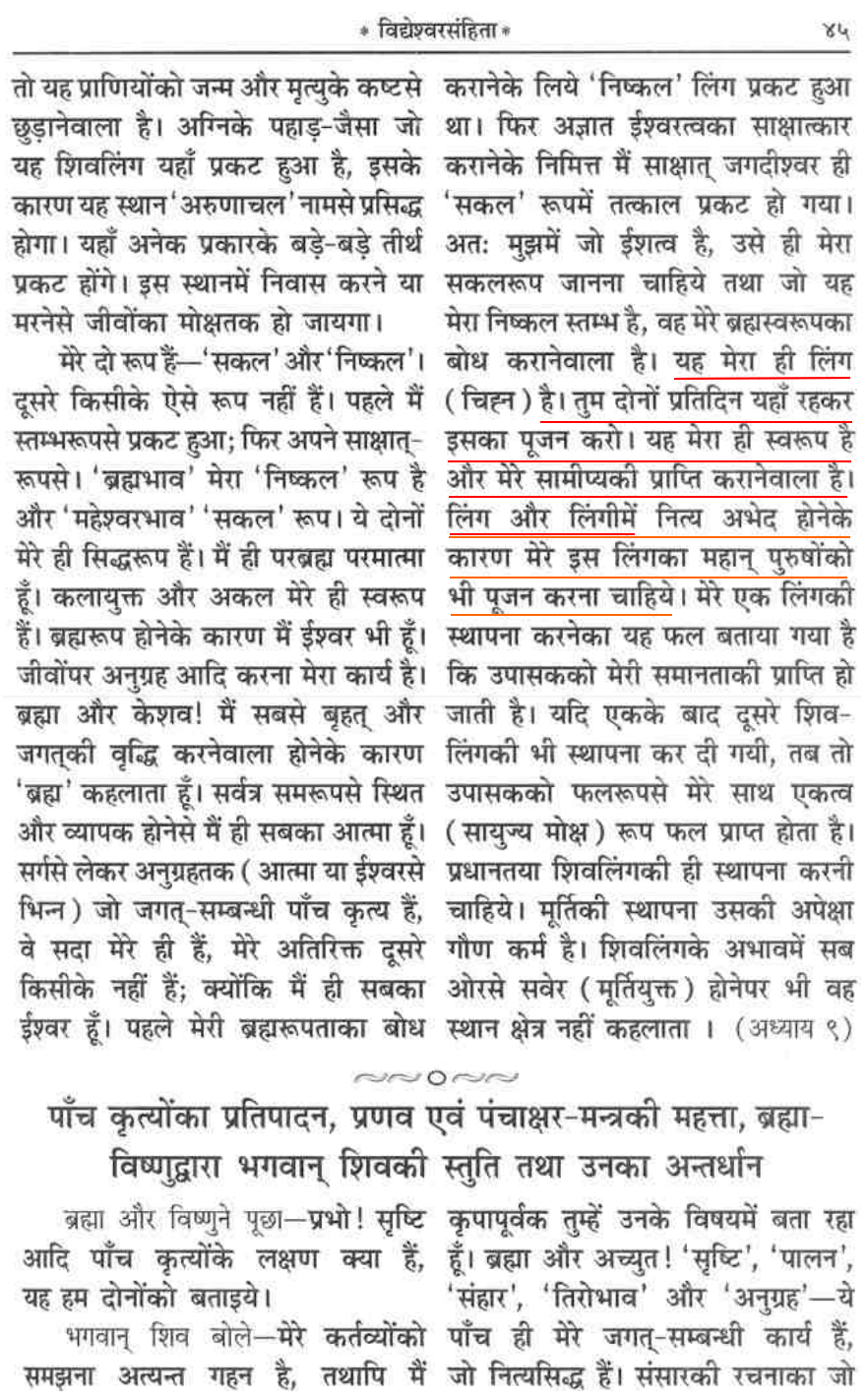
There is same account given in Shiv Puran from Gita Press Gorakhpur. See below.
Shiv Puran, Vidhweshwar Samhita, Adhyay 11, Page 21, Shlok 22-23
Khemdas Shri Krishan Das Publication
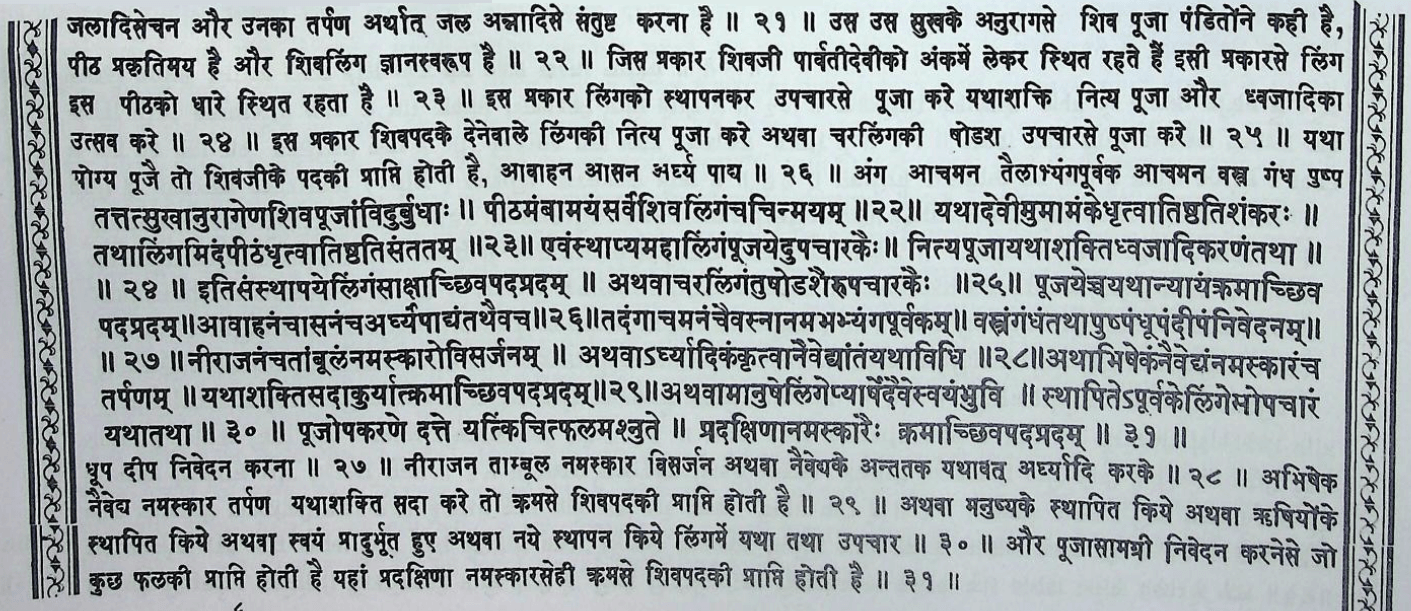
Shiv Puran, Vidhweshwar Samhita, Chapter 11, Verse 22-23 - English
22. With a love for the happiness of different beings Shiv Puja shall be performed-so say the wise men. The pedestal represents Shiv's consort-Parvati and his phallic emblem represents the sentient being.
23. Just as lord Shiv remains ever in close embrace of the Goddess Parvati, so also the phallic emblem holds on to the pedestal, for ever.
God Sadashiv then explains in detail in Shiv Puran how the Shiv Ling should be worshipped. Kaal basically with an aim to mislead people started this practice which is opposite to scriptures i.e. Vedas and Bhagavad Gita. Therefore it is a cause of decline and should be shunned.
The Curse of the Daruvana Forest - How Worship of Shiv Ling Started?
According to the KotiRudra Samhita, a pivotal moment in the history of the Shiv Ling takes place in the sacred Daruvana forest. The forest was home to a group of deeply devout sages who spent their days in rigorous meditation and ritual worship of Lord Shiva.
To test the depth of their devotion and humility, Lord Shiva decided to visit them. He assumed a highly unconventional, brilliant, yet stark naked form, covering his body only in holy ash. Wandering through the forest in this eccentric state, his presence sent shockwaves through the community. While the wives of the sages were completely transfixed, confused, and startled by this divine stranger, the returning sages were deeply offended.
Deluded by Shiva's cosmic illusion (Maya), the sages failed to recognise the supreme deity standing before them. Infuriated by what they perceived as a severe violation of Vedic decorum, they hurled a powerful curse at him: "Let your phallus fall to the ground!"
The Cosmic Firestorm
Instantly obeying the power of the sages' words, the phallus (shiv linga) of the deity detached and fell. However, instead of remaining a harmless object on the forest floor, it transformed into a catastrophic cosmic firestorm.
The fiery phallus began rapidly moving across creation, incinerating everything in its path. It tore through:
- Pataal (the underworld)
- Heaven (the celestial realms)
- Earth (the mortal world)
With the entire cosmos facing imminent destruction and unable to find peace, the terrified gods and sages fled to Lord Brahma for help.
The Intervention of the Goddess
Lord Brahma immediately reprimanded the sages for their spiritual arrogance and lack of hospitality toward a divine guest. He warned them that the universe would continue to burn until the wandering emblem was made stable.
Brahma revealed the only ultimate solution: Only Goddess Parvati could safely hold and pacify the volatile energy.
Following Brahma's ritual instructions, the gods and sages prayed to Goddess Parvati, begging her to manifest as the sacred, receptive pedestal. The Goddess answered their prayers, assuming the form of the pedestal to securely hold and embrace the fallen phallus. The moment she locked the phallus into place, the devastating fires ceased, balance was restored to the three worlds, and the established form of the Shiv Ling became the primary object of universal worship.
Shiv Purana - KotiRudra Samhita, Chapter 12
CHAPTER TWELVE
( The reason for Shiv's assuming the phallic form)
The sages said :
1. O Suta, you know every thing by the grace of Vyasa. There is nothing not known to you. Hence we approach you with a query.
2. The phallic form of Shiv is worshipped throughout the world. You have said so. Is there any special reason for the same ?
3. Parvati, the beloved of Shiv, is heard in the world in the form of an arrow. O Suta, what is the reason for this ? Please satisfy our curiosity in this respect by giving the account you have heard.
Suta said
4. O brahmins, the story of a different Kalpa was heard from Vyasa by me. O excellent sages, I shall narrate the same. Please listen.
5. What happened formerly among the brahmins in the Daruvana forest may kindly be heard. I shall narrate the same in the manner I have heard.
6. There is an excellent forest Daruvana. There were many excellent sages there, great devotees of Shiv who were always engrossed in meditation on Shiv.
7. O great sages, they performed the worship of Shiv incessantly thrice a day. They eulogised Shiv with different devotional hymns.
8. Once the leading brahmin devotees of Shiv engrossed in the meditation of Shiv went into the forest for bringing sacrificial twigs.
9. In the meantime Shiv himself assuming a very hideous form came there in order to test their devotion.
10. He was very brilliant but stark naked. He had smeared ashes all over his body as the sole ornament. Standing there and holding his penis he began to show all sorts of vicious tricks.
11. It was with a mind to do something pleasing to the forest-dwellers that Shiv, favourite of the devotees, came to the forest at his will.
12. The wives of the sages were extremely frightened at this sight. The other women excited and surprised approached the lord.
13. Some embraced him. Others held his hands. The women were engrossed in struggling with one another.
14. Meanwhile the great sages came there. On seeing him engaged in perverse activities they were pained and infuriated.
15. The sages, deluded by Shiv’s Maya and plunged in grief, began to say—“Who is this ? Who is this?”
16. When the naked sage did not reply, the great sages told that terrible Purusa.
17. ‘‘You are acting pervertedly. This violates the Vedic path. Hence let your penis fall on the ground.”
Suta said :
18. When they said thus, the penis of that Avadhuta, who was Shiv of wonderful form, fell down instantly.
19. That penis burnt everything in front; wherever it went it began to burn everything there.
20. It went to Pataal; it went to heaven; it went all over the earth; it never remained steady anywhere.
21. All the worlds and the people were distressed. The sages became grief-stricken. Whether gods or sages no one had any peace or joy.
22. All the gods and sages who did not recognize Shiv became sad. They assembled together and hastened to Brahma and sought refuge in him.
23. O brahmins, after going there, they bowed to and eulogised Brahma. They narrated what had happened to Brahma the Creator.
24 Brahma heard them. He realised that they had been deluded by Shiv’s Maya. After bowing to Shiv, he told the excellent sages.
Brahma said :
25. O brahmins, you though wise do such despicable things. Then why complain against the ignorant who act likewise ?
26-27. Who can wish for happiness after offending and antagonising Shiv thus? If a person does not welcome and serve a guest at midday, his virtue is taken away by the guest who in return deposits his sin in him. What then of Shiv himself as a guest ?
28. As long as the penis does not become stationary there cannot be anything good in the three worlds. I am telling you the truth.
29. O sages, you must do such things as will make the penis of Shiv steady. Please ponder over this in your minds.
Suta said: —
30. Thus urged, the sages bowed to Brahma and said—“O Brahma, what shall be done by us ? Please guide us in that task.’
31. When the great sages asked him thus, Brahma, the grandfather of the worlds, spoke to them.
Brahma said:
32. Let the gods propitiate goddess Parvatl and pray. If she can assume the form of the vaginal passage that penis will become steady
33. O excellent sages, listen. I shall tell you the mode of procedure. Act accordingly with love and devotion. She will be thus pleased.
34. Make an eight-petalled mystic diagram of lotus and place a pot over it. Water from holy centres shall be poured into the pot along with the sprouts of Durva and barley.
35. The pot shall be invoked with Vedic mantras. It shall be worshipped according to the Vedic rituals after remembering Shiv.
36. The penis shall be drenched with that water, O great s^ges. When the sprinkling is made with Satarudriya mantras it will become stable.
37. Parvati in the form of the Vaginal passage and an auspicions arrow shall form as the pedestal wherein the phallus shall be installed in accompaniment of the Vedic mantras.
38. Lord Shiv shall be propitiated with the offerings of sweet scents, sandal paste, fragrant flowers, incense and other things as well as by food offerings and other forms of worship.
39. With prostrations, holy hymns, musical instruments and songs he shall be propitiated further. Svastyayana mantras shall be repeated and the devotees shall proclaim the victory of the lord.
40. The following prayer shall be recited—“O lord of the gods, be pleased, O delighter of the universe. You are the creator, protector and the annihilator. You arc imperishable.
41. You are the beginning of the universe, the origin of the universe within the universe. “O lord Shiv, be quiet. Protect all the worlds.”
42. If this is performed there will be stability, to be sure. There will not be any aberration in the three worlds. There will be happiness always.
Suta said : —
43. O brahmins, thus advised, the gods bow^d to Brahma and then sought refuge in Shiv with a desire for the happiness of the worlds.
44. When worshipped with great devotion and implored, lord Shiv became delighted and spoke to them. Lord Shiv said :
45. O gods, O sages, you listen to my words with reverence. If my penis is supported in a vaginal passage there will be happiness.
46. Except Parvati, no other woman can hold my penis. Held by her my penis will immediately become quiet.
Suta said :
47. O great sages, on hearing those words the delighted sages and the gods took Brahma with them and prayed to Parvati.
48. After propitiating Parvati and the bull-bannered lord and performing the rites mentioned before, the excellent penis became static.
49. The gods and the sages propitiated Parvati and Shiv by the mode of procedure laid down in the Vedas for the sake of virtue.
50. Brahma, Vishnu and other gods, sages and the three worlds including the mobile and immobile beings worshipped Shiv particularly.
51. Shiv became delighted and so also Parvati, the mother of the universe. That phallus was held by her in that form then.
52. When the phallus was stabilised, there was welfare throughout the worlds. O brahmins, that phallus became famous in the three worlds.
53. The phallus is known as “HateSa” as well as “SiviShiv.” By worshipping it, all the people become happy in every respect.
54. Here everything will flourish in plenty conferring supreme happiness and bliss. Hereafter it will bestow final liberation. No doubt need be entertained in this respect.
References
- Shiv Puran - Khemdas Shri Krishan Das Publication Page 18
- Shiv Puran - Khemdas Shri Krishan Das Publication - Page 21
- Shiv Puran Chapter 11 - English
- Shiv Puran KotiRudra Samhita - Adhyay 12 Khemdas Publication - Hindi - Page 25
- Shiv Puran KotiRudra Samhita - Chapter 12 - English - Page 1296
- Shiv Puran Chapter 6 - English - Fight between Brahma and Vishnu
The Secret of Om AUM ॐ Mantra | Shiv Purana Chronicles of Brahma's Fifth Head - Shiv Puran
Categories: purana | Tags: