Shrimad Bhagavatam on Idol Worship: A Scriptural Renunciation
Introduction
Shrimad Bhagavatam is regarded as one of the most authoritative texts within Vaishnav and broader Hindu theology. Often cited to justify ritual practices, it is equally important to examine what the text explicitly discourages. A significant passage from the Bhagavatam categorically rejects idol worship and pilgrimage-centered ritualism when divorced from true spiritual knowledge and association with enlightened Saints.
This section of the Bhagavatam establishes that spiritual liberation does not arise from stone idols, rivers, or symbolic representations, but from true knowledge imparted by realized Saints.
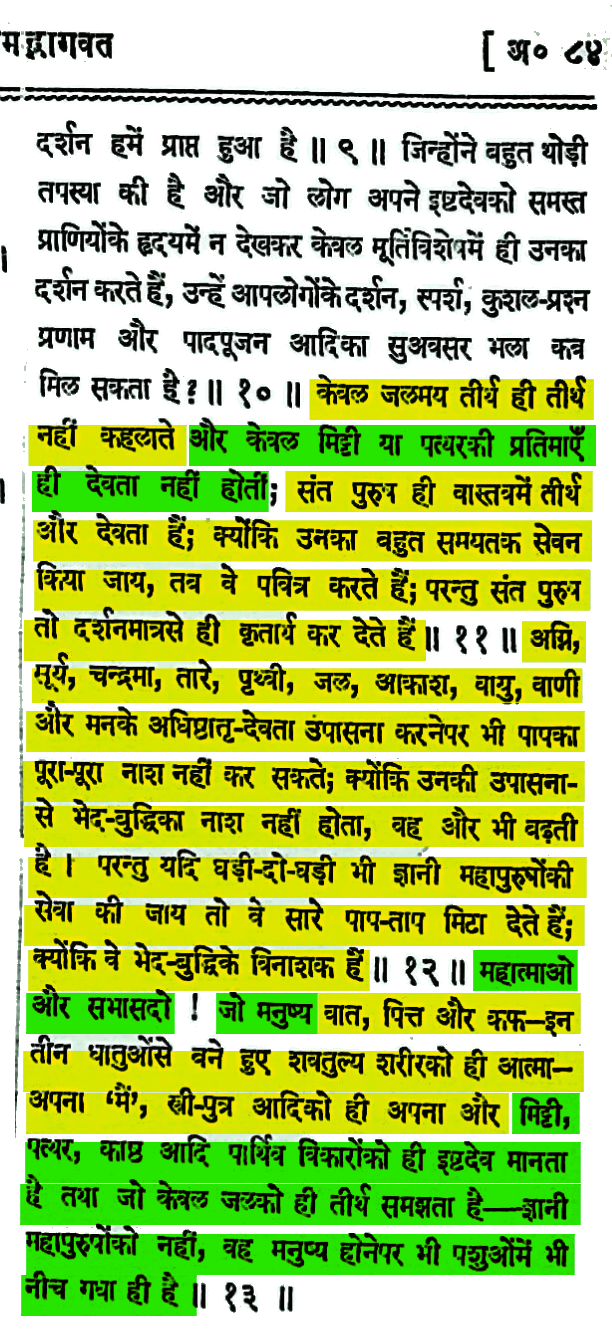
Idol Worship Is Declared Spiritually Ineffective
The text makes an unambiguous statement:
One should not consider stone, clay, wood, or metal images as God, nor should one believe that mere pilgrimage sites are holy in themselves.
The Bhagavatam asserts that stones and statues do not possess divine consciousness. Worshipping them as God is described as misguided, because divinity does not reside in inert matter.
The scripture emphasizes that:
- A stone idol cannot cleanse sins
- A symbolic form cannot grant liberation
- External rituals alone do not purify inner ignorance
Thus, idol worship is shown to be symbolic at best, but ineffective for salvation.
True Tirth (Holy Place) Is a Saint, Not a Location
The Bhagavatam redefines the very meaning of tirth (holy place):
A true holy place is not water, soil, or stone, but a Saint in whom divine knowledge resides.
It explains that rivers, mountains, and temples are not inherently purifying. They become sacred only when Saints reside there. Without the presence of enlightened souls, these locations remain materially unchanged.
This directly overturns the idea that:
- Bathing in rivers removes sins
- Visiting temples grants liberation
- Geography itself has spiritual power
Instead, the text states that Saints purify others instantly through wisdom, while lifeless objects cannot.
Saints Possess Transformative Power; Idols Do Not
The Bhagavatam draws a sharp contrast:
- Saints destroy ignorance and accumulated sins
- Idols and ritual objects cannot eliminate inner delusion
Even the presiding deities of natural elements—sun, moon, fire, air, water—are said to be incapable of removing subtle ignorance. If even these cosmic forces cannot liberate the soul, then stone images certainly cannot.
Liberation, according to the Bhagavatam, comes only through:
- Right knowledge
- Inner transformation
- Guidance from a realized Mahapurush
Worship Without Knowledge Leads to Degradation
The text delivers a strong warning:
One who considers the body, relatives, idols, or stones as the Supreme Reality, and ignores true knowledge, is classified as spiritually fallen.
Such a person is described as:
- Spiritually ignorant
- Bound to repeated birth and death
- Devoid of true understanding of God
This shows that blind ritualism is not neutral—it is spiritually regressive when it replaces true inquiry and knowledge.
Core Teaching of the Passage
The Bhagavatam passage conveys four decisive principles:
- God is not stone, wood, metal, or image
- Pilgrimage sites are not holy by themselves
- Saints are the true living tirths
- Liberation comes through knowledge, not rituals
Conclusion
This portion of Shrimad Bhagavatam stands as a powerful scriptural rejection of idol worship and ritual-centered spirituality. It aligns with the deeper Vedic principle that God is known through knowledge (gyan), not through symbols.
By elevating Saints above places and wisdom above rituals, the Bhagavatam calls seekers to move beyond external worship and toward true spiritual realization.
In doing so, it reminds humanity that salvation is not found in stone temples, but in living truth.
Ref:
Categories: purana | Tags: