The Narrative of Brahma and Shatarupa in the Matsya Purana
The Dark Mythology of Creation: Incest, Desire, and Moral Transgression in the Matsya Purana
In the study of ancient religious texts, few narratives provoke as much profound moral discomfort as the creation myths surrounding the deity Brahma. While later traditions often try to explain away or sanitize these stories using complex metaphors, a literal reading of the Matsya Purana (verses 32–45) presents a stark, deeply troubling account: a creator god who becomes consumed by an illicit attraction toward his own daughter, relentlessly pursues her, and ultimately forces her into marriage. By analyzing the text directly, we can unpack a narrative that openly violates universal moral boundaries.
Matsya Purana Page 22 - Hindi Text
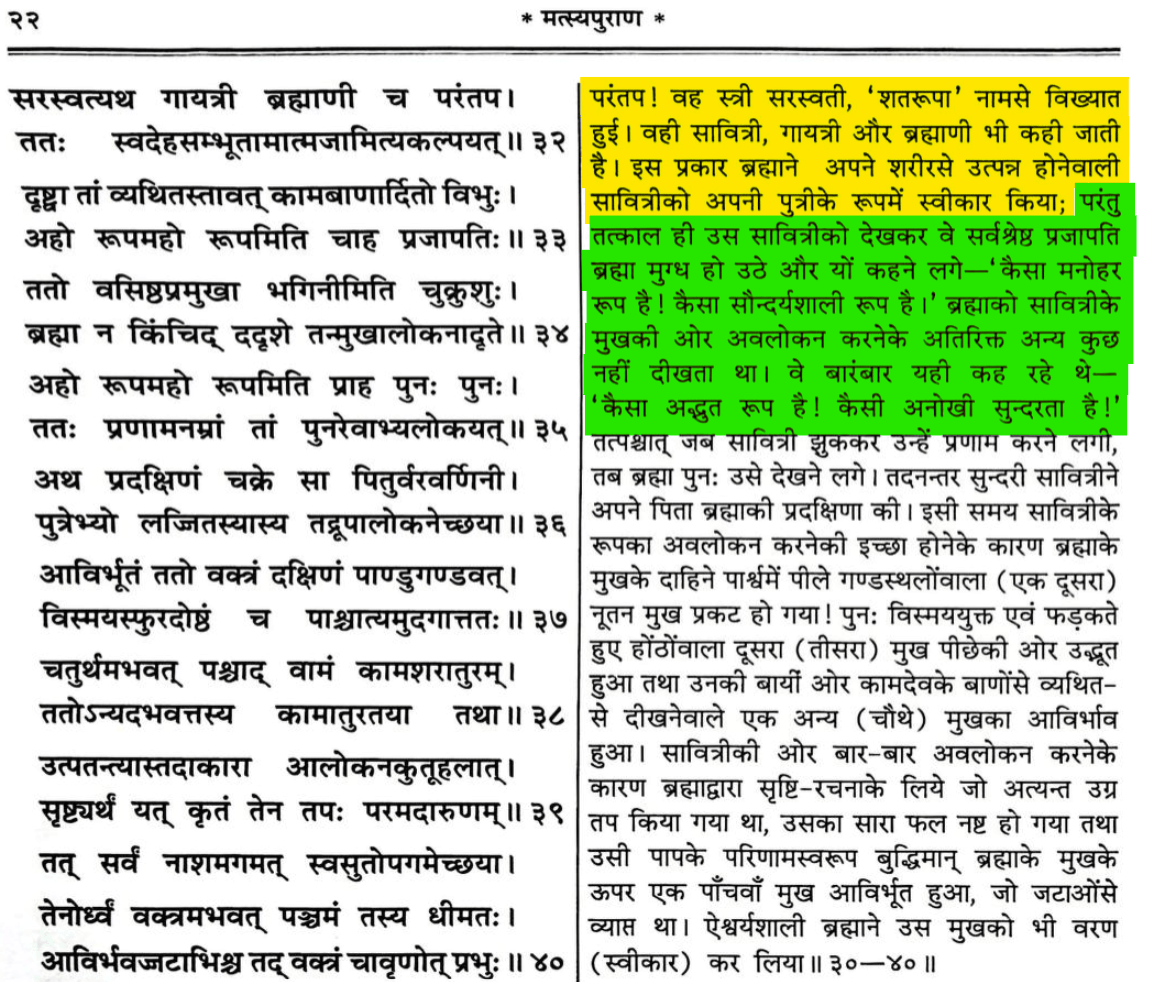
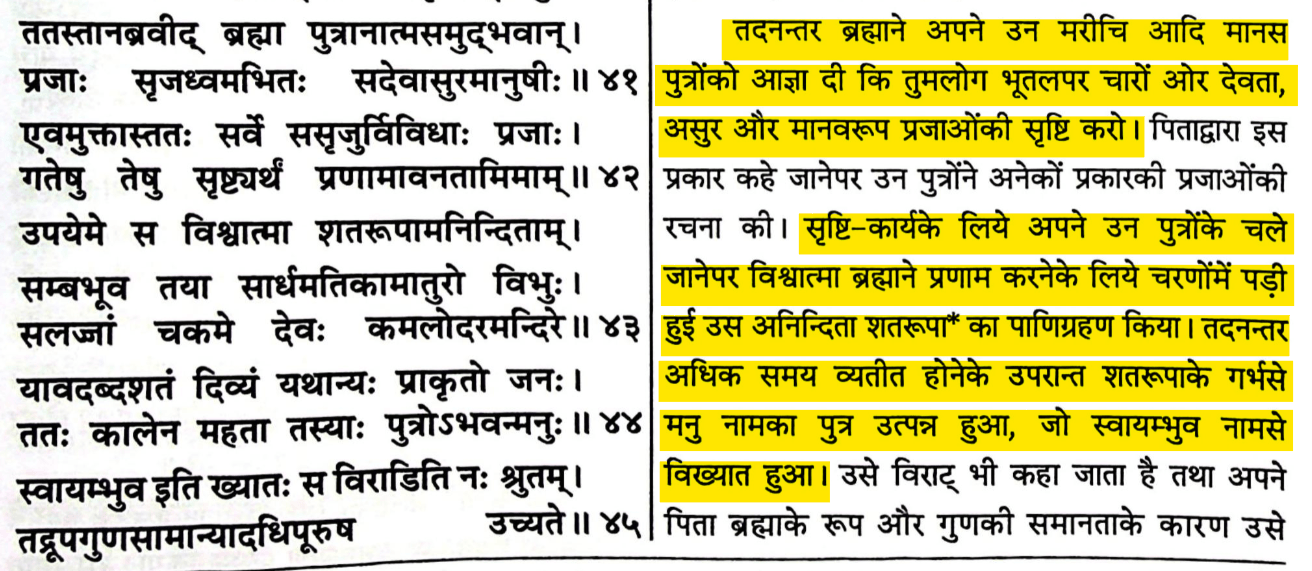
English translation of the Sanskrit verses and the corresponding Hindi commentary of the images above
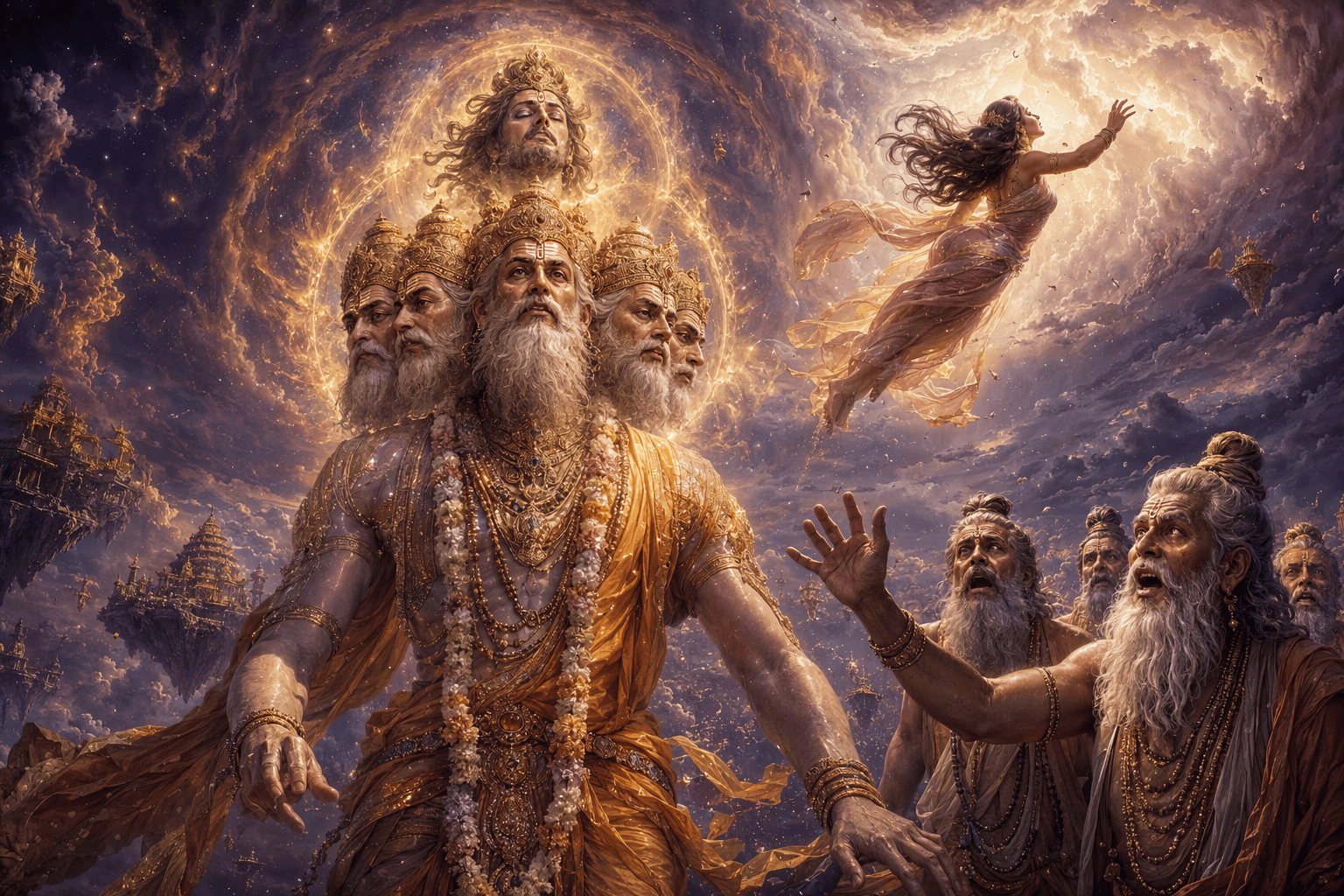
Verse 32–33: O Parantapa (Arjuna/O subduer of enemies)! That woman came to be known by the names Saraswati, Shatarupa, Savitri, Gayatri, and Brahmani. In this manner, Brahma accepted the woman born from his own body as his daughter. However, upon seeing that Savitri, the supreme progenitor (Brahma) was immediately struck by the arrows of desire (Kama) and became deeply infatuated. He began exclaiming, "Oh, what a captivating form! Oh, what a beautiful form!"
Verse 34–35: Sages like Vasistha and others loudly protested, calling out, "She is like a sister/daughter!" But Brahma did not see or hear anything else; his mind was entirely consumed by looking at her face. He repeatedly cried out, "Oh, what an extraordinary form! Oh, what unique beauty!" After this, when Savitri bowed down out of reverence to pay her respects (Pradakshina), Brahma continued to stare at her.
Verse 36–37: As beautiful Savitri circumambulated her father, Brahma's intense desire to behold her form caused a second (South) face with pale cheeks to manifest on the right side of his head. Then, a third (West) face, filled with wonder and quivering lips, manifested at the back of his head.
Verse 38–39: Following this, a fourth (North) face emerged on his left side, looking highly agitated and distressed by the arrows of the god of love (Kamadeva). As Savitri flew upward into the sky out of curiosity, Brahma, driven by the desire to look at her, caused a fifth head covered in matted hair (Jata) to emerge on top. Because of this desire to intimately possess his own daughter, all the immense ascetic power (Tapas) he had accumulated for creation was utterly destroyed.
Verse 40: The glorious Brahma accepted and bore that fifth head on top of his neck, which was covered in matted locks.
Verse 41–42: Following this, Brahma commanded his mind-born sons (such as Marichi and others), "Go forth onto the earth and create all kinds of offspring—including gods, demons, and humans." Upon receiving their father's command, the sons departed and created various kinds of living beings.
Verse 43: After his sons had departed for the work of creation, Brahma—the soul of the universe—captured the faultless Shatarupa, who had fallen at his feet out of respect. Deeply overcome by lust, the deity took the hand of the highly embarrassed and reluctant (salajjam) Shatarupa in marriage inside the temple of love.
Verse 44–45: After a very long period of divine time passed, Shatarupa gave birth to a son named Manu, who became famously known as Swayambhuva Manu. He is also referred to as Virat. Because he possessed the identical appearance, qualities, and virtues of his father Brahma, he is celebrated in the scriptures as the Adhipurusha (the primordial man). If you would like to integrate these direct translations as blockquotes or citations within the article, let me know! I can format them to seamlessly fit the flow of the narrative.
The Creation of a Daughter
The text begins with Brahma generating a beautiful female entity directly out of his own physical body. She is given multiple names - Shatarupa, Savitri, Gayatri, and Brahmani. Because she is explicitly born from his own flesh, the text directly identifies her as his daughter (atmajam). However, instead of assuming the role of a protective father, Brahma is instantly overcome by an intense, consuming sexual desire (Kama-bana).
The Relentless Pursuit and the Multiplied Heads
What follows is a narrative of a daughter trying to escape the unwanted gaze of her father, and the father using his cosmic powers to stop her retreat:
- The Four Cardinal Faces: Out of deep respect, Shatarupa attempts to circumambulate (Pradakshina) Brahma. As she moves around him to the right, back, and left, Brahma refuses to turn his body. Instead, he grows three new faces (South, West, and North) just to keep his eyes locked on her.
- The Fifth Head: Desperate to escape his predatory gaze, Shatarupa flies upward into the sky. In response, a fifth head grows on top of Brahma's neck, explicitly driven by a desperate curiosity to see her (alokanakutuhalat). This sequence vividly portrays a complete breakdown of paternal morality. The daughter attempts to show traditional reverence, while the father responds by multiplying his anatomy to ensure she can never escape his sight.
The Destruction of Spiritual Merit
The Matsya Purana does not gloss over the moral severity of Brahma's actions. Verse 39 explicitly states that because of his desire to intimately possess his own daughter (svasutopagamechchhaya), the entirety of the immense spiritual merit and ascetic power (Tapas) that Brahma had accumulated to create the universe was instantly destroyed. By framing this loss of Tapas as a direct consequence of his desire, the text acknowledges that Brahma’s fixated lust was a massive spiritual regression and a violation of cosmic order (Dharma).
Forced Union and the Lineage of Humanity
Despite the loss of his spiritual purity and the clear moral boundaries crossed, the narrative moves to an unavoidable, dark conclusion. After sending his mind-born sons away to populate the rest of the world, Brahma corners the deeply embarrassed and reluctant (salajjam) Shatarupa. The text states that he enters the "temple of love" with her, marrying his own daughter and living with her as a husband. From this highly controversial, morally compromised union, the first human lawmaker, Swayambhuva Manu, is eventually born.
A Stark Moral Dilemma
For modern readers and ethical thinkers, this passage from the Matsya Purana presents an intense moral crisis. It depicts the foundation of human existence not as an act of pure, divine grace, but as the byproduct of a forbidden, incestuous obsession. By portraying the supreme creator god as a being who succumbs to base, immoral impulses against his own offspring, the text leaves readers with a haunting depiction of power, desire, and the violation of the ultimate taboo at the very dawn of time.
Controversial Feast of Lord Shiva - Padma Purana The Tulsi and Vishnu Account from Brahm Vaivarta Purana
