The Story of Amogha and Brahma in Padma Purana
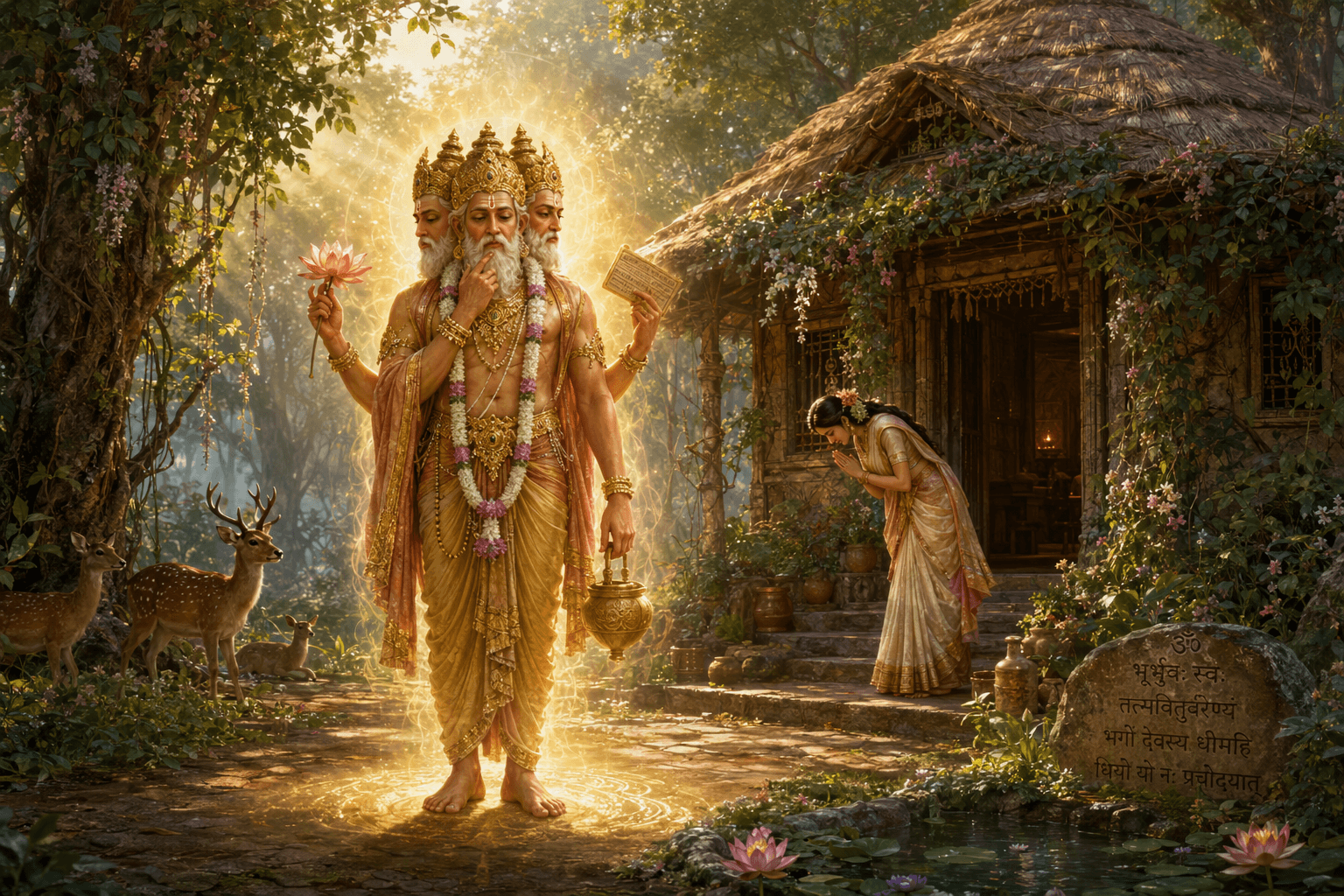
Among the eighteen major Mahapuranas, the Padma Purana holds a treasure trove of legends. One such fascinating yet rarely discussed narrative is found in the Srishti-khanda (the book of creation), which explains the mystical and complex birth of the Lauhitya River (popularly known as the Brahmaputra).
This story explores the overwhelming power of cosmic desire (Kama), the vulnerability of the creator god Brahma, and how a seemingly scandalous event ultimately resulted in the manifestation of one of India's most sacred, purifying river systems.
The All-Powerful Might of Kama (Desire)
The text from the Padma Purana begins with a deep philosophical reflection on the nature of desire. The scripture declares that Kama (lust/sensual desire) is completely durnivar- utterly irresistible and unavoidable - not just for ordinary humans, but for all living beings, deities (Devas), and demons (Asuras) alike.
Padma Purana Page 731-732 - Hindi Text
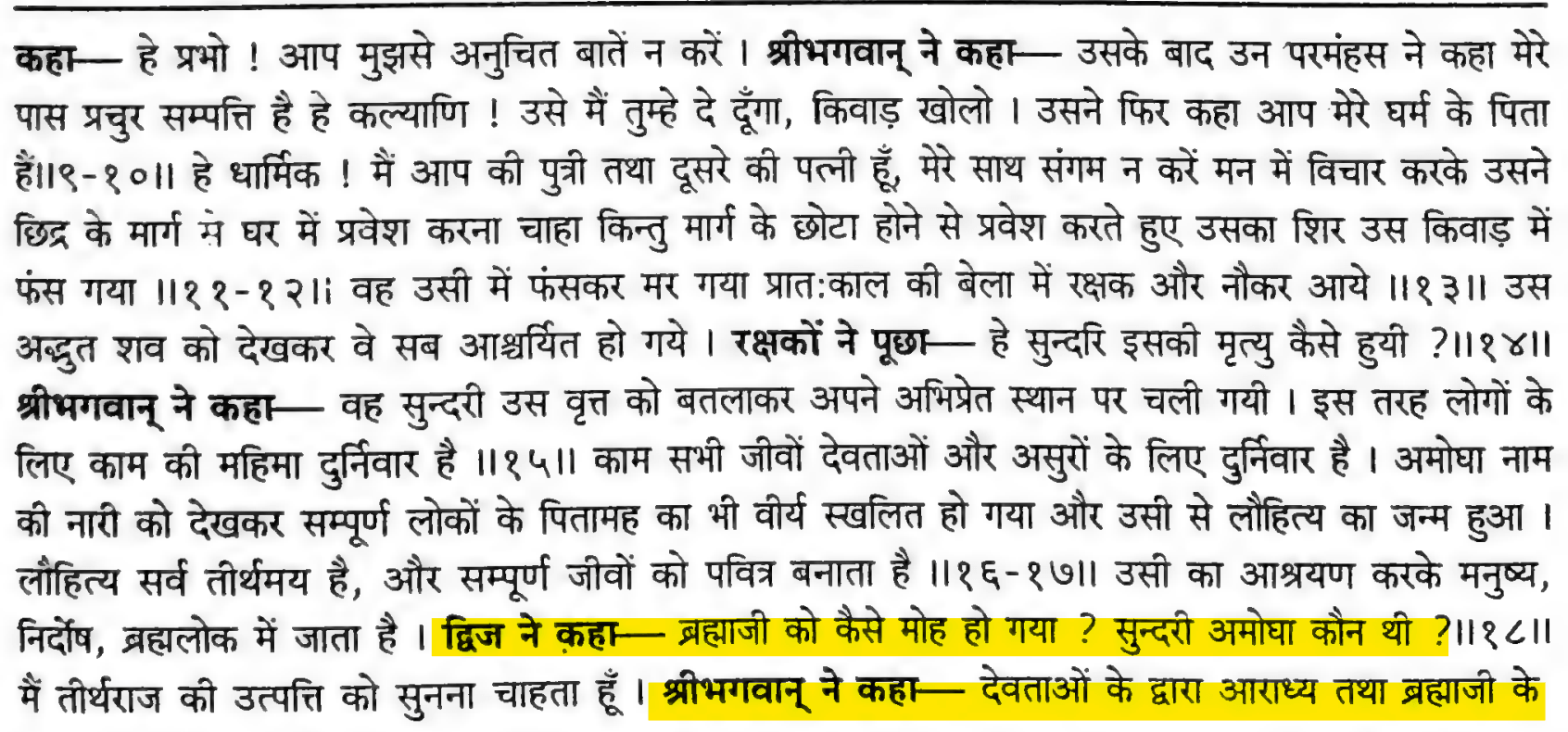
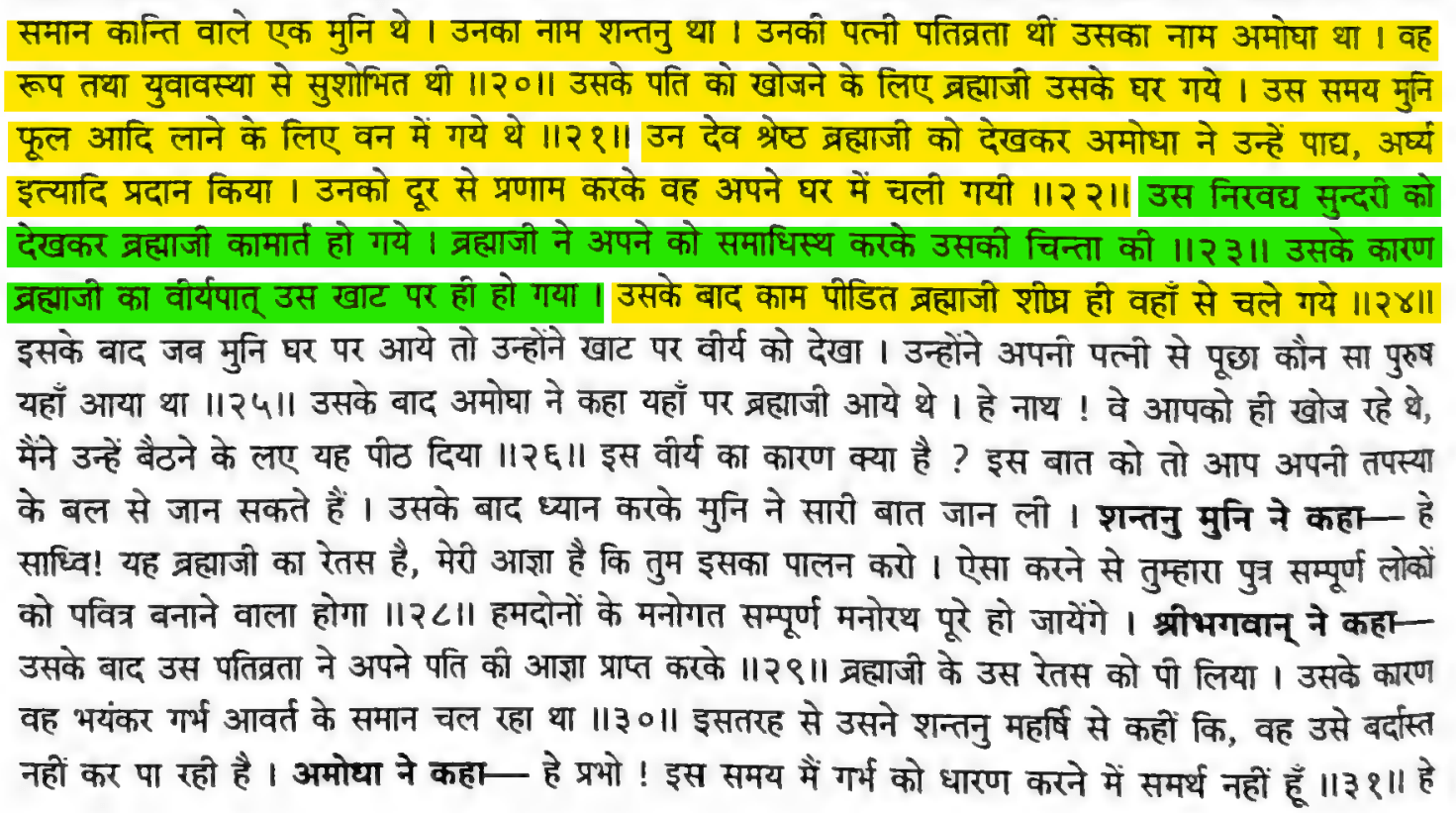
English Translation
The Dvija asked - How did Lord Brahma become so infatuated? Who was the beautiful Amogha? I want to hear about the origin of the king of pilgrimages. The Lord said - He who is worshipped by the deities, and of Brahma...
There was a sage of equal brilliance named Shantanu. His devoted, faithful wife was named Amogha. She was adorned with supreme beauty and youth.
To look for her husband, Lord Brahma went to their house. At that time, the sage had gone to the forest to gather flowers and other items. Seeing the foremost among gods, Brahma, Amogha offered him water to wash his feet (padya) and holy offerings (arghya). Bowing to him from a distance, she went inside her house.
Upon seeing that flawlessly beautiful woman, Lord Brahma became overwhelmed by desire. Brahma stabilized himself in a meditative state and thought about her. Because of this, Brahma's vital energy (semen) discharged right there on the cot.
Afflicted by desire, Brahma quickly departed from that place. Later, when the sage returned home, he saw the vital energy on the cot. He asked his wife, "Which man came here?"
Amogha replied, "Lord Brahma came here. O master! He was looking for you. I gave him this seat to sit on. What is the cause of this vital energy? You can know this through the power of your penance (tapasya)." After meditating, the sage understood everything. Sage Shantanu said, "O virtuous wife! This is the essence (retas) of Lord Brahma. It is my command that you consume/nurture it. By doing so, your son will make the entire universe pure, and the deepest desires of both our minds will be fulfilled."
The Lord said - Thereafter, that faithful wife, obtaining the command of her husband, drank the essence of Brahma. Because of this, it felt as though a terrible, swirling whirlpool was moving within her womb. She then told Sage Shantanu that she could not bear it. Amogha said, "O Lord! At this time, I am unable to sustain this womb..."
Lord Brahma’s Vulnerability and the Enchantment of Amogha
The text describes a pivotal event from the Padma Purana involving Sage Shantanu, his exceptionally beautiful and devoted wife Amogha, and the creator god Lord Brahma.
The Arrival of Brahma: Lord Brahma visits the hermitage of Sage Shantanu to meet him. However, the sage is away in the forest gathering flowers and sacrificial materials.
The Cosmic Infatuation: Amogha receives Lord Brahma with utmost Vedic hospitality, offering him water (padya) and respect (arghya) before retiring indoors. Upon seeing her flawless beauty and youth, Lord Brahma is instantly overwhelmed by intense sensual desire (Kama). Despite attempting to stabilize his mind through meditation (samadhi), his vital energy (virya) involuntarily discharges onto a cot in the house, after which he quickly departs in embarrassment.
The Sage's Discovery and Command: When Sage Shantanu returns, he notices the discharge on the cot and questions his wife. Amogha explains Brahma's visit but suggests her husband use his meditative powers to uncover the truth. Through divine vision, Shantanu realizes what happened. Instead of becoming angry, he recognizes the cosmic potential of Brahma's divine essence. He commands his faithful wife to consume it, explaining that the resulting child will be a supreme purifier of the universe and will fulfill their spiritual destinies.
The Burden of the Womb: Obeying her husband's command, Amogha drinks the essence. Immediately, she experiences a violent, turbulent sensation within her womb, resembling a raging whirlpool. The text ends with Amogha crying out to her husband in distress, stating that the immense divine power is unbearable and she cannot sustain the pregnancy.
The Birth of the Sacred Lauhitya River
The vital force that emanated from Lord Brahma due to his attraction to Amogha did not go to waste. The text states that from this divine essence, Lauhitya was born after Amogha discharged the vital force.
The word Lauhitya translates literally to "reddish" or "blood-red," denoting both the color characteristics of the river’s sediment and its origin from vital energy. In modern geography, Lauhitya is the ancient, scriptural name for the massive Brahmaputra River that flows through Tibet, Northeast India, and Bangladesh. Unlike most Indian rivers which are personified as goddesses, the Brahmaputra is unique because it is celebrated as a Nada (a male river)—the literal son of Brahma.
Conclusion
The narrative in this section highlights a foundational theme in Puranic literature: the absolute and irresistible power of cosmic desire (Kama), to which even the creator Brahma is vulnerable.
Ref:
