Skanda Purana: Meat Eating
Skanda Purana - Kashi Khand - Ancient Wisdom on Karma, Meat Eating, and Empathy
The Skanda Purana, one of the great Puranic texts of Hindu tradition, contains a powerful teaching on non-violence toward living beings. In the Kashi Khanda, the discussion goes beyond the simple question of eating meat. It examines the entire chain of violence: killing, permitting killing, preparing, purchasing, selling, serving, and ordering the killing of another living being.
At the heart of these teachings is a simple principle: one who seeks happiness for oneself should recognize the same desire for happiness in every other living being.
The text begins with a strong condemnation of killing animals merely for the nourishment of one's own body. It states:
Key lines
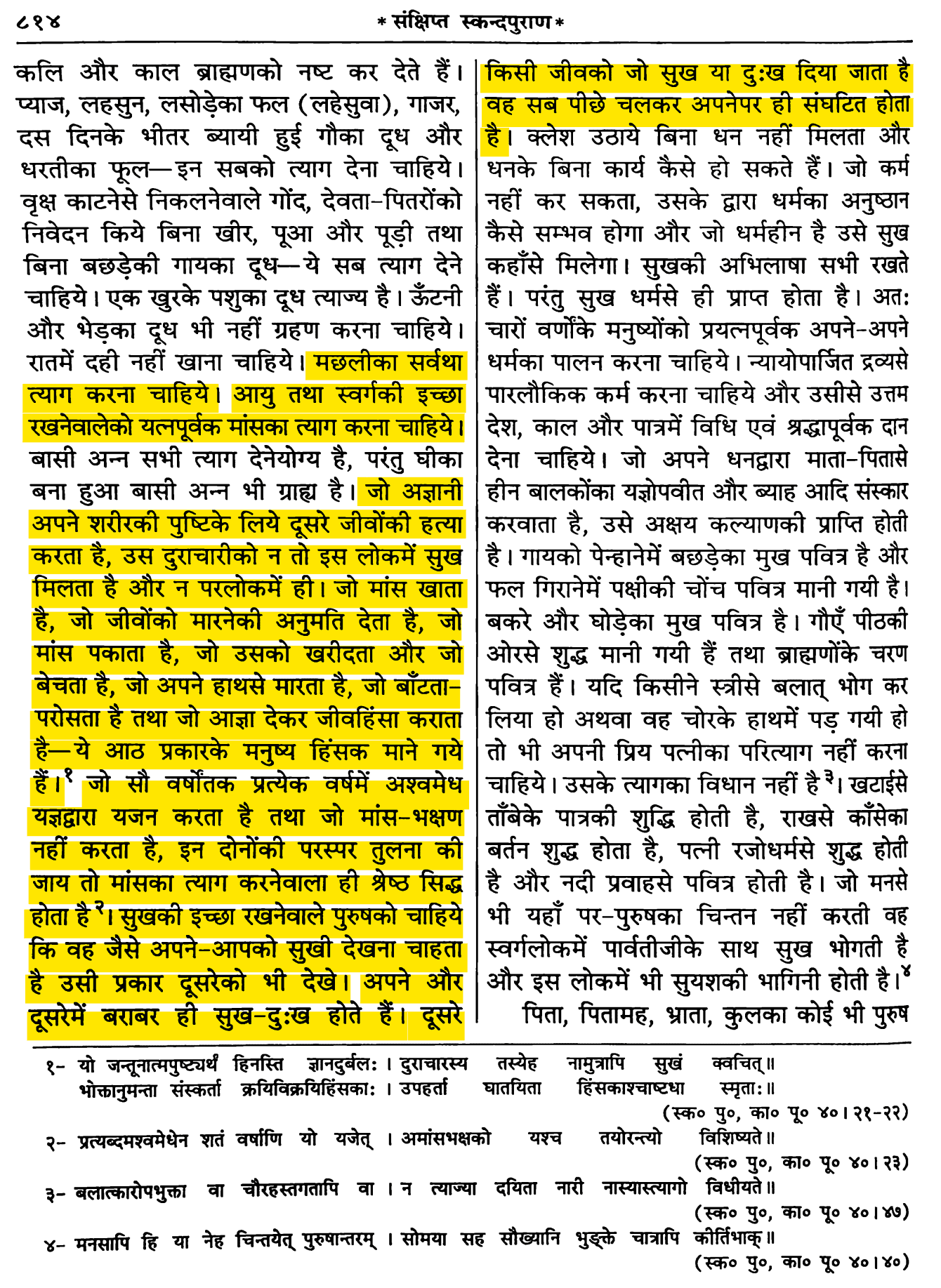
जो अज्ञानी अपने शरीरकी पुष्टिके लिये दूसरे जीवोंकी हत्या करता है, उस दुराचारीको न तो इस लोकमें सुख मिलता है और न परलोकमें ही।
The ignorant person who exploits and destroys the lives of other living beings simply for the nourishment and growth of their own body—that wrongdoer finds happiness neither in this world nor in the world beyond.
जो मांस खाता है, जो जीवोंको मारनेकी अनुमति देता है, जो मांस पकाता है, जो उसको खरीदता है और जो बेचता है, जो अपने हाथसे मारता है, जो बाँटता-परोसता है तथा जो आज्ञा देकर जीवहिंसा कराता है—ये आठ प्रकारके मनुष्य हिंसक माने गये हैं।
The one who eats meat, the one who gives permission to kill living beings, the one who cooks the meat, the one who buys it, the one who sells it, the one who strikes with their own hand (slays), the one who serves it, and the one who commands or gives the order to commit violence—these eight types of men are deemed to be perpetrators of violence.
जो सौ वर्षोतक प्रत्येक वर्षमें अश्वमेध यज्ञद्वारा यजन करता है तथा जो मांस-भक्षण नहीं करता है, इन दोनोंकी परस्पर तुलना की जाय तो मांसका त्याग करनेवाला ही श्रेष्ठ सिद्ध होता है।
If a comparison is made between a person who performs the grand Ashwamedha sacrifice every year for a hundred consecutive years, and a person who completely abstains from meat consumption—the one who has renounced meat is proven to be the superior and perfected soul.
सुखकी इच्छा रखनेवाले पुरुषको चाहिये कि वह जैसे अपने-आपको सुखी देखना चाहता है उसी प्रकार दूसरेको भी देखे। अपने और दूसरेमें बराबर ही सुख-दुःख होते हैं।
A man who desires his own happiness must look upon others in the exact same manner that he wishes to see his own self happy. Within oneself and within others, joy and sorrow are entirely equal.
किसी जीवको जो सुख या दुःख दिया जाता है वह सब पीछे चलकर अपनेपर ही संघटित होता है।
Whatever joy or sorrow is given to any living being, that very same experience moves forward, organizes itself, and eventually manifests upon oneself.
Violence Is Not Limited to the Person Who Kills
One of the most striking passages expands the idea of responsibility for violence. The text identifies eight categories of people associated with the killing of animals:
- The person who eats meat.
- The person who gives permission for an animal to be killed.
- The person who cooks the meat.
- The person who purchases it.
- The person who sells it.
- The person who personally kills the animal.
- The person who serves or distributes the meat.
- The person who orders or commands the killing.
The person holding the weapon is not presented as the only participant. The person who creates demand, facilitates the act, purchases its result, prepares it, or instructs another to perform it is also included within the text's conception of responsibility.
Renouncing Meat Is Compared With the Ashvamedha
The text then makes an extraordinary comparison.
It says that if one person performs the Ashvamedha sacrifice every year for one hundred years, while another person simply abstains from eating meat, the person who has renounced meat is regarded as superior. The Ashvamedha was one of the most prestigious and elaborate Vedic royal sacrifices. Against such an enormous ritual undertaking, the text places something apparently much simpler: the conscious decision not to consume the flesh of another living being.
Seeing Others as Oneself
Every person instinctively wishes to experience happiness and avoid suffering. The text asks us to recognize that the same fundamental impulse exists in other living beings.
The Law of Karma and the Return of Actions
The final teaching makes the connection with karma explicit:
“Whatever joy or sorrow is given to any living being, that very same experience moves forward ... and eventually manifests upon oneself.”
This expresses the classical karmic principle that actions have consequences for the person who performs them.
In this view, harming another being is not an isolated event that disappears once the act is over. The moral consequences of an action continue beyond the immediate moment.
Conclusion Summary
- Life is valuable beyond the boundaries of one's own body.
- Violence involves not only the direct killer but those who participate in and facilitate it.
- Renunciation of meat is presented as an exceptionally meritorious act.
- Other living beings are to be regarded as sharing our fundamental desire for happiness.
- Actions toward other beings carry karmic consequences for ourselves.
Skanda Purana - Kashi Khand - Gita Press Gorakhpur
Ref:
Bhavishya Purana Shrimad Bhagavatam on Idol Worship: A Scriptural Renunciation
Categories: purana | Tags: