The True Story of Mansur Al-Hallaj (Mansur Ali) and Shams Tabrizi
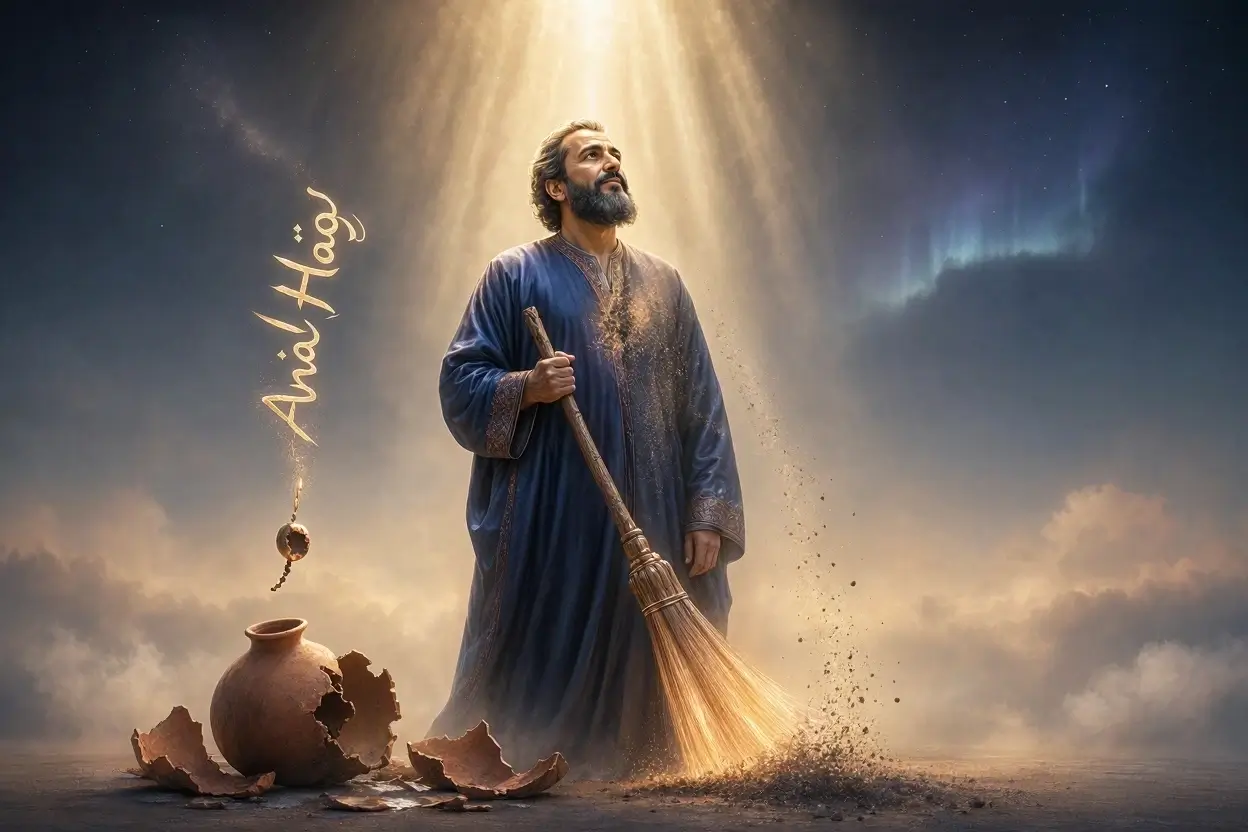
The Secret Awakening outside Baghdad
There once lived a virtuous Muslim soul named Shams Tabrizi, who resided in a quiet hermitage inside a dense forest just outside the historic city of Baghdad. According to His divine principle of rescuing pious souls, the Supreme Lord - Almighty Kabir - descended from the eternal realms and appeared before Shams Tabrizi in the humble guise of a Zinda Baba (a living ascetic).
The Supreme Lord unfolded the true nature of the cosmos to the Sufi mystic. He revealed His absolute identity as Allahu Akbar (Almighty Kabir), granted him a breathtaking vision of Satlok (the eternal, supreme world), and gently returned him to his physical frame. Following this divine revelation, the Zinda Baba vanished from sight, leaving Shams Tabrizi with a single, highly secretive mantra: "Anal Haq".
Traditional Islamic clerics heavily misinterpreted the words "Anal Haq," falsely declaring its meaning to be "I am Allah" (asserting that the individual soul itself is God). In absolute truth, that yatharth mantra is "Soham". It is not a phrase to be intellectually picked apart or translated for its literal meaning; rather, it is a powerful vashikaran mantra to be chanted with total devotion to connect with and control the senses to reach the Supreme Being (Akshar Purush). Deeply anchored in this sacred practice, Shams Tabrizi spent his days in quiet isolation, chanting the True Name.
The Order of the Divine Switch
As the months passed, the orthodox opposition against Shams Tabrizi escalated violently within the city. Seeing the danger, Supreme God Kabir deployed a profound divine play. Through a secret, inner inspiration, He induced a powerful desire within the real Shams Tabrizi's heart to abandon his hermitage and travel far away.
The moment the mystic departed, Kabir Sahib Himself assumed the exact physical form of Shams Tabrizi and began living in the original ashram. His divine target was clear: He had descended to rescue his beloved soul, Prince Mansur Ali. Prince Mansur Ali is famously known in Sufi history as Mansur Al-Hallaj
Following severe persecution from the local rulers and public, the disguised Lord - acting as the Pir - gathered his close followers and migrated to the bustling city of Multan (located in modern-day Pakistan) to establish a fresh sanctuary of devotion.
The Spying Prince and the Miracle of the Sky Nectar
In the city of Multan, a profound spiritual awakening began to unfold. The daughter of the ruling King, a pious young princess named Shimli, became deeply captivated by the spiritual discourses and miraculous powers of the new Pir. Transformed into an ultimate devotee, she spent her days and nights lost in the meditation of the True Name. With her father’s royal permission, she visited the isolated ashram twice every day, faithfully preparing and carrying fresh meals for her Satguru every morning and evening.
However, the sensory distractions and malicious gossip of the material world soon crept into the palace. A city critic approached Princess Shimli’s brother, the high-strung Prince Mansur Ali / Mansur Al-Hallaj, warning him: "Your sister visits the ashram alone under the cover of evening. This does not befit royal nobility, and the entire city is whispering in criticism."
Driven by a sudden impulse of suspicion, Mansur secretly followed his sister to the ashram that very evening. Crouching outside the mud walls, he found a small hole in the brickwork and began to spy on the activities within. Inside, the princess respectfully served the meal, after which the Satguru began to deliver a powerful spiritual discourse.
Mansur listened intently from the dark, determined to find a flaw. But as the words of the true spiritual knowledge (Tatvagyan) entered his ears, they pierced his heart. He heard the profound truth that devotion to the Creator is mandatory; Allah is not formless but possesses a majestic physical form, He is Kabir, and He manifests on Earth in a human body.
On standard days, the discourse lasted for a brief half-hour, but that night, the Lord extended the sermon for two full hours. Mansur absorbed every single word, his cynical mind completely shattered by the weight of the spiritual truth.
The Miracle of the Descending Bowls
Following the discourse, Shams Tabrizi and Shimli held out their open palms toward the heavens, praying for prasad. To Mansur’s absolute bewilderment, two radiant bowls filled with heavenly nectar descended gracefully from the sky, landing perfectly in their hands.
The Satguru drank only half of his portion. Turning to the princess, He said, "Daughter, take this remaining nectar prasad and pour it through the hole in the wall to feed the dog standing outside. Its inner self is heavily weighed down by sin, and this divine elixir will instantly cleanse its heart."
Bound to execute her Guru's command flawlessly, Shimli approached the wall. The Pir called out, "Throw it directly through the hole. If you step outside, the beast will take fright and flee."
Shimli cast the liquid through the small opening. Outside, Mansur’s mouth happened to be slightly open in utter amazement, and the entire stream of heavenly nectar poured straight down his throat! Instantly, his inner consciousness was completely purified, and an intense, burning longing to surrender to the Satguru awakened within his soul.
Rushing to the entrance of the ashram, the Prince threw himself prostrate at the feet of Guru Shams Tabrizi. He confessed the sinful spy mission of his mind, wept bitterly, and begged for salvation. Seeing his absolute surrender, the Satguru warmly accepted him into His refuge and granted him the primary initiation.
The Martyrdom of Mansur Ali
Mansur became an unstoppable force of absolute devotion. He discarded his royal privileges and began pacing the city streets, loudly and ecstatically chanting the mantra "Anal Haq".
This sparked immediate and furious outrage among the orthodox Islamic clerics (Qazis). They falsely accused him of becoming an infidel (Kafir) who described God as a physical human being. Furthermore, by misinterpreting "Anal Haq," they claimed Mansur was arrogantly declaring himself to be Allah. They marched to the palace, demanding that the King either burn his son alive or permanently silence his tongue.
Because Mansur was a crown prince, no ordinary citizen dared to harm him. The King attempted to counsel his son in front of the entire court, but Mansur remained completely intoxicated by divine love, continuously chanting Anal Haq. Frustrated, the King turned to the gathered crowd, demanding: "What punishment shall be given to this boy?"
The public shouted, "Tie the کافر (infidel) to the central crossroads! Let every citizen carry a half-kilogram stone and pelt him. If he utters Anal Haq, strike him and move forward. Out of pure physical exhaustion, he will abandon this blasphemous language!"
The Cry of the Flower
The next morning, thousands of citizens formed a massive queue at the crossroads, each clutching a heavy stone. Standing silently within that crowd was Princess Shimli. Her heart was torn; she held a stone in one hand to appease the public, but secretly concealed a fresh flower in the other, thinking, "He is my brother and a fellow devotee. I shall throw the flower instead of the stone. The crowd will see me strike him, yet my brother will feel no pain."
One by one, the citizens stepped forward, issuing the ultimatum: "Renounce Anal Haq, or face the stone!" Mansur merely smiled, his eyes fixed on the heavens, and cried out, "Anal Haq, Anal Haq!"
Stones rained down upon his frame, fracturing his bones, tearing his flesh, and leaving his body completely blood-stained. Yet, the lover of God laughed in pure joy.
Finally, Princess Shimli stepped to the front. She uttered no words, but gently tossed the flower toward him. The moment the soft petals brushed his wounded chest, Mansur burst into an agonizing, bitter weeping.
Shimli rushed forward, whispering in bewilderment, "Brother! The crowd pelted you with heavy stones that broke your flesh, yet you smiled and laughed. I only threw a soft flower that carries no pain - why do you weep so bitterly?"
Mansur looked at her through his tears and replied:
"O sister! This innocent public is entirely blind; they have no knowledge of the path of divine sacrifice, so their stones carry no emotional pain for me. But you! You possess the true knowledge! You are the very soul who guided me to the refuge of the Satguru! When your hand rose against me, your flower struck my soul with a force a thousand times more painful than any stone. The Murshid (Guru Ji) will never forgive this lapse of faith!"
The Ashes That Spoke
Seeing that the Prince refused to bend, the religious custodians dragged his mangled body back to the King, declaring that religion stood far above royal lineage. They issued a final decree: renounce the name, or face complete dismemberment.
Mansur was brought before the executioner’s block. "Renounce it now, or we shall sever your hand!" the guards shouted. Mansur calmly extended his right hand toward the flashing sword and declared, "Anal Haq!" The blade fell, severing his hand.
"Renounce it, or lose the other!" Mansur extended his left hand, crying out, "Anal Haq!" The second hand was severed.
Finally, the executioner raised the blade to his throat. "If you utter those words again, your life ends!" Mansur roared with the full strength of his soul, "Anal Haq! Anal Haq! Anal Haq!" The heavy blade fell, decapitating the prince.
Determined to erase his memory, the clerics gathered his remains, burnt his flesh to ashes, and cast the dust into the rushing river. But the Supreme Lord willed an unexplainable miracle: from every single grain of floating ash, the loud, resonant echo of "Anal Haq! Anal Haq!" began to vibrate across the waters!
Within minutes, the divine energy rippled through the city. A thousand identical manifestations of Mansur Ali suddenly appeared, walking through every alley, market, and street of the city, loudly chanting Anal Haq. Terrified by the cosmic display, the citizens fled into their homes, locking their doors in sheer panic. Once the lesson was absolute, Almighty Kabir drew the divine play to a close, and the manifestations vanished into thin air.
The Satguru then changed Mansur’s physical form, blessed him with the identity of Muhammad, and the Master and disciple departed the region, journeying deep into Hindustan toward the prominent city of Multan.
The Mystical Hymn of Mansur Ali
Before his historic martyrdom, Mansur Ali recorded a revolutionary spiritual song (Shabad). It was a direct, uncompromising wake-up call to the blind religious leaders (Qazis) of his era, urging them to look past empty, outward rituals and seek the true internal intoxication of the Divine Name.
“Agar hai shauk Allah se milne ka, to hardam naam lau lagata ja.”
(If you truly possess the desire to meet Allah, then fix your devotion on the True Name with every incoming and outgoing breath.)
Shabad in Hindi
अगर है शौक अल्लाह से मिलने का, तो हरदम नाम लौ लगाता जा।।(टेक)।।
न रख रोजा, न मर भूखा, न कर सिजदा। वजू का तोड़ दे कूजा, शराबे नाम जाम पीता जा।।1
पकड़ कर ईश्क का झाड़ू, साफ कर दिल के हूजरे को। दूई की धूल रख सिर पर, मूसल्ले पर उड़ाता जा।।2
धागा तोड़ दे तसबी, किताबें डाल पानी में। मसाइक बनकर क्या करना, मजीखत को जलाता जा।।3
कहै मन्सूर काजी से, निवाला कूफर का मत खा। अनल हक्क नाम बर हक है, यही कलमा सुनाता जा।।4
English
Agar hai shauk Allah se milne ka, to hardam naam lau lagata ja ||(Tek)||
Na rakh roza, na mar bhukha, na masjid ja, na kar sijda |
Vaju ka tod de kuja, sharabe naam jaam peeta ja ||1||
Pakad kar Ishq ki jhaadu, saaf kar dil ke hujre ko |
Dui ki dhul rakh sir par, musalle par udata ja ||2||
Dhaga tod de tasbi, kitaabein daal pani mein |
Masaik bankar kya karna, majikhat ko jalata ja||3||
Kahe Mansur kaaji se, niwala kufar ka mat kha |
Anal Haqq naam bar haq hai, yahi kalma sunata ja ||4||
Explanation of the Original Shabad in English
"Na rakh roja, na mar bhookha, na kar sijda. Vaju ka tod de kooja, sharabe naam jaam peeta ja."
(Do not keep fasts, do not starve your physical frame, and do not perform blind prostrations. Break the clay vessel used for ritual washing; instead, drink deeply from the chalice of the wine of the Divine Name.)
"Pakad kar eeshk ka jhaadoo, saaf kar dil ke hoojre ko. Duee ki dhool rakh sir par, moosalle par udata ja."
(Take up the powerful broom of divine love and sweep clean the inner chamber of your heart. Throw the dust of duality and jealousy upon your head, and blow it away from your prayer mat.)
"Dhaga tod de tasbi, kitabein daal paani mein. Masaik bankar kya karna, majikhat ko jalata ja."
(Break the string of your rosary beads and cast your textbooks into the water. What is the use of pretending to be a grand religious guide? Go and burn away your spiritual vanity and pride.)
"Kahai Mansoor kaazi se, nivala koofar ka mat kha. Anal Hakk naam bar hak hai, yahi kalma sunata ja."
(Mansur says to the Qazi: stop consuming the bread of sin by slaughtering innocent animals. The name 'Anal Haq' is the absolute spiritual truth—keep reciting this true kalima.)
Explanation
Mansur Al Hallaj says that if you have the desire to meet (attain) God, then immerse yourself in the name of that Lord and remember that God with every breath.
There is no need to starve by keeping roza (fasting in Islam) and likewise, there is no need to do sijdah (kneel and touch forehead on earth) in a mosque. Manur Al Hallaj said this to stress that God doesn't reside in a mosque.
Mansur stresses that the general notion that one cannot worship or pray to God without doing vaju (washing of hands and feet) is a farce. So figuratively Mansur says, break that pot in which you bring water for vaju. Rather indulge in the intoxication of God's name.
Develop intense love for God and cleanse your heart with the broom of love. Destroy the jealousy inside you.
Break the rosary beacause you are not chanting the true name of God. Likewise the books that you are relying upon (Ingil, Tohrat, Zaboor and Quran) and are under a belief that it will grant you salvation, throw them in water because your belief is false. Burn the arrogance as this false pride is of no use.
Manur Al Hallaj addresses Qaji and says that stop committing sin by killing living beings such as goat, cow etc. Instead, recite the Anal Haq mantra of God and read this kalma to everyone.
The Miracle of the Sun in Multan
Upon establishing their camp in the city of Multan, the presence of Satguru Shams Tabrizi and Prince Muhammad attracted many virtuous souls. However, because their method of worship rejected traditional Islamic rituals, the local orthodox population began a fierce campaign of harassment. They threatened the new followers and completely barred them from entering the ashram gates.
Eventually, the ashram ran completely out of firewood, leaving them with no means to cook food. The Satguru turned to Prince Muhammad, handed him a portion of dough, and said, "Son, roll this into a single thick flatbread (Baati). Take it into the city markets and request someone to bake it upon their home fire."
The young prince entered the city streets, humbly holding out the raw dough. But the hostile citizens rejected his requests. Instead, a group of violent men struck the young disciple across the face, fracturing his features, and chased him out of the city.
Muhammad returned to the camp bleeding and empty-handed, weeping as he showed his injuries to the Master: "Satguru Ji! The people have reduced me to this state, and they refused to provide even a spark of fire to bake our bread."
Seeing the cruelty inflicted upon his beloved disciple, the Satguru’s eyes flashed with divine authority. He took the raw flatbread and placed it directly onto his open palm. Facing the sky, he looked up at the sun and commanded: "Come down here this instant, and bake my flatbread!"
The Wrath of the Heavens
At the supreme command of the Satguru, the sun instantly broke its orbit and began descending toward the Earth. The temperature skyrocketed to an unendurable degree. The entire city of Multan turned into a literal furnace - mud walls began to scald, wooden doors baked, and the earth began to burn under the intense, blinding heat.
Realizing their imminent destruction, the terrified elders and ministers of Multan rushed to the ashram, throwing themselves prostrate before the Pir. They folded their hands and begged for mercy: "Holy One! These citizens are ignorant fools who did not recognize your power! For the sake of the Almighty, do not punish the entire city for the misdeeds of a few wicked men!"
Hearing them invoke the name of the Creator, the Satguru relented. He looked up at the descending sun and commanded it to return to its original position, remarking quietly, "If these people cannot endure a few moments of this earthly heat, how will their souls ever survive the agonizing fires of hell (Dozakh)?"
Instantly, the sun retreated to its proper orbit, and the scorching heat faded away. Overwhelmed by awe, the entire population of Multan surrendered to His feet and began entering the path of true devotion.
The Final Timeline and the Return of the True Pir
To maintain the strict historical ledger of the world, Kabir Sahib - who was acting out the role of Shams Tabrizi - then prepared his final departure. The real Shams Tabrizi had previously fallen into a profound state of grief and total silence (Mauni) after witnessing the brutal martyrdom of his disciple Mansur in Baghdad. To mirror this reality, Kabir Ji had also intentionally observed a strict vow of silence in Multan for several days.
One bright morning, following His regular routine, Kabir Ji walked out of the ashram gates under the pretext of a morning walk and simply vanished from the material timeline.
At that exact hour, the real, silent Shams Tabrizi - who had been wandering in distant lands - miraculously arrived at the gates of the Multan ashram. Because his physical appearance was identical, the attendants and devotees noticed no difference, smiling as they thought, "Our beloved Pir has returned from his morning walk."
Shams Tabrizi stepped inside the sanctuary and immediately cast off his physical frame, peacefully entering his final rest. To this very day, traditional historians remain entirely unaware of this divine switch. The local people buried his holy body in a grand grave, and a magnificent memorial was erected over the site in the year 1329.
The Legacy of Kamali
Decades later, from 1398 to 1518, Supreme God Kabir descended once more, performing His magnificent divine plays in the holy city of Kashi (Varanasi, India) for a span of 120 years. During this incarnation, the Lord famously resurrected a young deceased girl named Kamali straight from her grave, restoring her to life and raising her within His household.
When Kamali grew into a young woman and learned the extraordinary history of how her Satguru had once turned Multan into a furnace to protect Prince Muhammad, an intense, spiritual longing arose within her heart to reside in that sacred city. Understanding her pure intention, Kabir Sahib gracefully arranged her marriage into the household of an ultimate, dedicated devotee residing right within the historic city of Multan, sealing the divine connection across the centuries.
The fully enlightened mystic, Saint Garibdas Ji of Chhudani, recorded this cosmic intervention within his sacred verses (Bani):
गरीब, सतगुरू समस्तरबेज कूं, बाटी धरिया हाथ।
सूरज कूं सेकी जहां, तेजपुंज का गात।।
Meaning: Satguru Shams Tabrizi placed the raw flatbread (Baati) upon his bare palm and commanded the sun to bake it. At that supreme moment, the physical frame of the Satguru transformed into a brilliant, blinding mass of radiant divine light (Tejpunj), and under that ultimate heat, the bread was baked to perfection.
Essential Spiritual Realizations for the Soul
- The Illusion of Outward Rituals: As Mansur Ali fearlessly declared to the clerics, heavy fasting (Rozas), physical prostrations (Namaz), and outward washings (Wudu) are empty shells if the "chamber of the heart" remains full of pride and the sin of animal slaughter (Zabh).
- The Shield of the Satguru: The vices of the mind (Vikaar) are never truly dead; they remain buried like hot coals under ash. Only absolute, unwavering shelter under a true Master can permanently extinguish them.
- God is Formful: Supreme God Kabir is not a formless void. He is a majestic, formful being who continuously descends into the lower worlds in various disguises - such as Al-Khidr or a Jinda Baba - to protect his chosen souls and break the heavy chains of Kaal.