The True Story of Sultan Ibrahim Ibn Adham of Balkh Bokhara
The Origins of Adham Shah Fakir
There once lived a devout ascetic named Adham Shah, who had built a humble hut a short distance outside the historic city of Balkh. During one of his regular walks through the city, he happened to see the only daughter of the Emperor of Balkh. Deeply struck by her youth and beauty, a powerful desire arose within him to marry the princess.
Approaching the Emperor directly, Adham Shah demanded, “Marry this girl to me.” While the Sultan was astonished by the fakir’s bold request, he also feared the potential spiritual consequences of a mystic's curse. Unable to give an immediate answer, he asked the fakir to return the following day. In the meantime, the royal ministers devised a plan. They decided to set an impossible condition, informing Adham Shah the next morning: “To marry the Emperor's daughter, you must bring a necklace or a hundred pearls. Otherwise, this marriage cannot take place.”

Determined to fulfill the demand, the fakir set off to find the treasure. Upon learning that pearls are found deep within the ocean, he travelled to the seashore. There, he began a desperate task - filling his pot with seawater and pouring it onto the distant sand. He toiled relentlessly for days on end without food or water, pushing his body to the brink of collapse. Passersby who witnessed his struggle warned him, saying, “You left your home to seek Allah, yet now you are paving your path to hell. The ocean can never be emptied. Return to your worship.”
Seeing his plight, the Supreme God appeared on the shore disguised as Jinda Baba (a muslim saint). He approached Adham Shah and asked, “What are you doing here?”
Adham Shah replied, “I wish to marry the Emperor's daughter, but they have demanded a collection of pearls. I was told pearls reside in the sea, so I will empty this ocean to claim them.”
Jinda Baba cautioned him, “The ocean cannot be emptied, and you will only perish from hunger and thirst. If you redirect this immense effort toward attaining the salvation for which you originally left home, your life will be fruitful. Instead, you are choosing to destroy it.”
Impatiently, Adham Shah dismissed the warning: “I do not need your teachings. I am doing my work; you mind yours.”
Supreme God Kabir has stated that: -
Vikaar marey mat jaaniya, jyon bhoobhal (ash) mein aag |
Jab karellae dhadhakahin, koee bachae Satguru sharan laag ||
The Miracle of the Pearls and the Princess's Revival
Adham Shah’s stubborn determination mirrored the foolishness of the worldly-minded. Just as a man lost in ignorance dismisses the wise, the fakir refused to listen. Seeing that his beloved devotee would surely perish from exhaustion, the Supreme Lord - manifested as Kabir Jinda Baba (Al-Khijr) - willed a miracle. By His divine power, a massive oceanic wave surged and crashed against the coast, depositing thousands of radiant, flawless pearls onto the sand.
Cryingly exclaiming, "Ya Allah!", Adham Shah eagerly gathered thousands of the pearls, binding them securely in a cloth sheet. He marched directly into the Emperor’s court, cast the treasure before the throne, and demanded, “Fulfill your royal promise and marry the princess to me.”
Instead of honoring the vow, the deceitful ministers ordered the royal guards to beat the mystic mercilessly with staffs and cast his body deep into the forest to rot. Yet, by the ultimate grace of God, Adham Shah survived. Though severely broken, he slowly recovered his strength and was able to move within a few weeks.
Shortly after his recovery, tragedy struck the palace: the Emperor’s young daughter unexpectedly passed away. Following her burial, four guards were stationed at her tomb to protect the body from wild scavengers. Hearing of her death, Adham Shah crept to the graveyard under the cover of night. Finding the guards deep in a miraculous sleep, he carefully uncovered the grave, retrieved the princess's shrouded body, and meticulously restored the earth to its original state before carrying her corpse back to his isolated hut.
That very night, a caravan of wandering nomads lost their way in the dense forest. Spotting the faint glimmer of a lamp inside Adham Shah’s hut, two men approached to ask for a spark of fire against the bitter winter cold. Inside, the princess's shrouded form had been propped against the wall, sitting upright with her legs crossed. Hearing the approaching footsteps and fearing the Emperor’s wrathful guards had tracked him down, Adham Shah fled out the back and hid inside the cave where he performed his spiritual practices.
When the two nomads stepped inside and saw the lifeless young woman sitting against the wall, they fled back to their camp in terror. Among their caravan was a skilled physician. Intrigued, the doctor and several clan members returned to investigate. Upon examining her, the physician declared, "This maiden is not dead; she has merely fallen into a profound, death-like state of shock. I can revive her."
The caravan leader agreed, saying, "Administer the treatment. If she awakens, we shall ask her who her father or husband is." After respectfully draping a fresh sheet over her form, the physician made a precise incision in her wrist, drawing out the stagnant, impure blood.
Within minutes, the princess gasped and regained consciousness, looking around in bewilderment. "Where am I? How did I come to this place?" she asked.
Watching from the shadows, Adham Shah realised by the lamplight that these were travellers, not the Sultan's executioners, and saw that the princess had miraculously returned to life. Stepping into the light, he recounted the entire extraordinary tale to the nomads as the princess listened in awe.
Deeply moved, the caravan elders spoke to the girl: "Had this fakir not pulled you from the cold depths of the grave and brought you here, you would have perished in the earth. Rest now in the knowledge that this is the divine will of Allah, and take this mystic as your husband."
The princess consented, and the travellers solemnized their marriage then and there. The generous caravan leader offered, "If you wish to travel with us, we will serve you gladly and ensure you never face hardship again."
But the fakir, now transitioned into the life of a householder, replied gratefully, "We wish to remain here in this sacred solitude. I shall never forget your profound kindness. You came to this hut as an embodiment of Allah Himself; without you, we both would have met our end. You have saved our lives."
With blessings of peace, the nomads departed, leaving the newlyweds together in the quiet forest.
The Birth and Early Life of Sultan Ibrahim
In the quiet sanctuary of the forest, the princess gave birth to a beautiful son, whom they named Ibrahim. When the child turned four years old, his parents decided to enroll him under the tutelage of a prominent Maulvi (Islamic scholar) in the city of Balkh. Every morning, Adham Shah would walk his young son to the city to study, and every evening he would faithfully return to bring him back to their humble hut.
Now, the Emperor of Balkh had never been blessed with a son, having only loved his late daughter. Known for his immense charity, the Sultan frequently visited the local madrasas to reward students, distribute clothes to the impoverished, and aid poor children. During one such visit to the Maulvi's school, the Emperor’s eyes fell upon young Ibrahim. He was instantly captivated and astonished by the boy's striking appearance, for his face bore an uncanny, breathtaking resemblance to his deceased daughter.
Deeply moved, the Emperor turned to the cleric and asked, “Whose child is this?”
The Maulvi replied, “A fakir from the deep forest brings him here. He leaves the boy in our care each morning and collects him at twilight. Beyond that, we have not questioned him.”
As if guided by an invisible, divine bond, the young boy stepped forward and warmly embraced the Emperor. Overflowing with affection, the ruler lifted Ibrahim into his arms and prepared to depart, instructing the cleric: “When his father arrives this evening, send him directly to the palace. He may collect his son there.”
The Emperor brought the child home and presented him to the Queen. The moment her eyes fell upon the boy, the memory of her lost daughter overwhelmed her so intensely that she fainted onto the marble floor. Upon regaining consciousness, she wept and wrapped the child in a fierce embrace. With her own royal hands, she lovingly prepared a feast of rich rice pudding and sweet halwa for him, whispering through tears, “This child is the living image of our beloved daughter.”
Meanwhile, Adham Shah arrived at the school, only to be directed straight to the royal court. The Emperor had already commanded his guards: “Should the father of this boy arrive, do not bar his entry. Escort him into the palace with the utmost respect.”
When the humble ascetic was brought before the throne, the Emperor looked at him and demanded, “Tell me truly, whose child is this?”
Adham Shah looked into the Emperor's eyes and answered calmly, “He is my child. He was born unto your own daughter.”
Stunned and defensive, the Emperor retorted, “It does not befit a holy fakir to utter such falsehoods!”
In response, Adham Shah calmly recounted the entire extraordinary sequence of events, from the miraculous wave of pearls to the caravan physician's revival of the princess. Still wrestling with disbelief, the Emperor immediately ordered his daughter's tomb to be disinterred. When the earth was pulled back, the grave was found entirely empty. The Emperor then rushed out to the forest to find the fakir's hidden hut. There, sitting quietly in a simple, patched dress, was his daughter. The moment she recognized her parents, she rushed forward, throwing her arms around them in an emotional reunion.
Overwhelmed with joy and gratitude, the Emperor brought his daughter, his grandson, and the fakir back to live within the palace walls. He formally proclaimed the mystic Adham Shah as his royal successor, granting him the title of Shah - a crown prince born of spiritual nobility.
Yet, the extravagant luxuries and material wealth of the palace brought no peace to Adham Shah's wandering soul. Within a few days, he bade his royal family a loving farewell and returned to the quietude of his forest hut, journeying back only occasionally to visit his wife and son.
A few years later, Adham Shah Fakir peacefully passed away. A sacred tomb was erected where his hut once stood, surrounded by a magnificent, blooming garden. Young Ibrahim, was officially crowned and ascended the throne as Sultan Ibrahim, the rightful heir to his grandfather's grand kingdom.
Point to consider:
Kabir kamaai aapni, kabahu na nishfal jaay |
Saat samandar aadey padey, miley agaau aay ||
Meaning - Whatever spiritual earnings a devotee accumulates through true worship can never go in vain. Even if they must cross obstacles as vast as the seven oceans, the fruits of their devotion will always come forward to meet them.
A devotee’s physical lineage and inherent nature play a monumental role in their spiritual journey. When a child is born to truly righteous parents, the pure nature of those ancestors is naturally woven into the child's soul and body. To fully comprehend the extraordinary life of Sultan Ibrahim, one must look at the past lives of his soul:
- The First Lifetime (Samman Maniyar): In a previous incarnation, this soul was a devoted disciple named Samman Maniyar. Due to profound spiritual trials, Samman had even sacrificed his own son, Seu, in the service of his Satguru. Seeing his supreme devotion, Supreme God Kabir resurrected the boy.
- The Second Lifetime (Emperor Nausher Khan): As a reward for his immense sacrifice, the soul was reborn as a wealthy monarch named Nausher Khan. In this lifetime, he distributed billions of rupees in religious charity (Zakat). However, surrounded by royal luxuries, he neglected his actual spiritual practice and did not perform true worship.
- The Current Lifetime (Sultan Ibrahim): Because the karmic rewards of his past charity still needed to be delivered, Almighty Kabir orchestrated a magnificent divine play.
To guide this wandering soul back toward absolute salvation, the Supreme Lord induced a powerful desire within the lifelong ascetic, Adham Shah, to marry the princess. Every event that followed was carefully orchestrated by divine will: the sudden manifestation of pearls on the seashore, the princess falling into a death-like shock, the nomad caravan losing its way in the blizzard, and the subsequent revival of the maiden.
Through this divine orchestration, the soul of Samman was born as Sultan Ibrahim to a profoundly pious mother. Though born a princess, she had willingly embraced a life of rigorous saintly simplicity alongside a fakir, completely shielding her son from the spiritual evils of the material world.
There was also a profound historical justice executed through this lineage. Generations earlier, Adham Shah’s own grandfather had been the rightful Emperor of Balkh, but his kingdom was violently seized in a war by the ancestors of Ibrahim's maternal grandfather. By orchestrating this marriage, Supreme God Kabir seamlessly returned the kingdom to its rightful ancestral bloodline through young Sultan Ibrahim.
Yet, this story serves as a stark spiritual warning. Even a deeply devoted soul like Adham Shah eventually deviated from the strict path of true worship due to his worldly desires - and as a consequence of that spiritual lapse, his soul was later forced into the lower birth of an animal.
Supreme God Kabir has stated:
Ye sab khel hamaare kiye | Ham se miley jo nishchay jeeye ||
Jo jan meri sharan hai, uska hoon main daas |
Gail gail laagya firoon, jab tak dharti aakaash ||
Taking Sultan Ibrahim in Refuge: The 7 Diving Acts
Almighty God Kabir, in the guise of the immortal sage Jinda Baba (Al-Khijr), repeatedly exhorted Sultan Ibrahim to awaken his soul.
After finishing his historic past life as the selfless devotee Samman, that pious soul departed his physical form and was reborn as the wealthy Emperor Nausher Khan. Following that incarnation, the soul ascended to the throne as the legendary Sultan Ibrahim Adham. His capital was the magnificent city of Balkh.
As a direct reward for the profound devotion he had performed as Samman—where his ultimate sacrifice was offering his own son to the Satguru alongside a humble offering of flour—the soul was continuously blessed with prosperous human births. In his subsequent life as Nausher Khan, Supreme God Kabir had intentionally orchestrated circumstances to encourage his immense charity. Because of these accumulated spiritual merits, he became the most affluent king of Balkh, commanding an army of eighteen lakh (1.8 million) horses, boundless reserves of diamonds, and royal shoes studded with jewels worth lakhs. Yet, surrounded by sixteen thousand women and the intoxicating luxuries of the palace, the Sultan lost himself in worldly pleasures and grew deeply fond of violent royal hunting expeditions.
One evening, a group of genuine mystics gathered at a devotee's house near the royal palace to deliver spiritual discourses. Sitting high upon his palace roof in the quiet of the night, the Sultan overheard their entire sermon. The words pierced his heart, inspiring an intense desire to seek God. The very next morning, he commanded his ministers: “Find a true saint; I wish to seek their spiritual guidance.”
The Deception of the False Saint
At that time, a highly famous but fraudulent ascetic resided in the kingdom. Seeking to impress the monarch, this sly hypocrite pretended to be a great renunciant who would never touch material wealth or money. Sultan Ibrahim was deeply impressed by his apparent holiness. However, noticing a priceless diamond ring on the king's finger, the fraudulent guru quietly instructed his closest attendant: “Go to the royal goldsmith who crafted the Sultan's ring. Have him fashion an identical counterfeit made of fake gold and imitation gems.”
OWhen the duplicate ring was ready, it looked indistinguishable from the original. A few days later, the false saint invited the Sultan for a boat ride on a deep lake. Once they reached the middle of the waters, the guru remarked smoothly, “O King, your ring is remarkably beautiful. May I examine it closely?”
The unsuspecting Sultan slipped the ring off and handed it over. Using sleight of hand, the fraud surreptitiously swapped the rings. Misinterpreting the guru's long gaze, Ibrahim offered, “If it pleases you, Holy One, you may keep it. Or, I can have another crafted for you.”
The hypocritical saint scoffed, pretending to be detached from the world. “To a true sage, such baubles are mere dirt!” he exclaimed, dramatically casting the fake ring into the depths of the lake.
Witnessing this, the Sultan returned to his palace entirely convinced that the Baba was a peerless master of detachment. However, the deception did not remain hidden for long. A disgruntled disciple of the fraud eventually exposed the truth to the King, revealing exactly how the genuine ring had been stolen. When royal guards raided the guru’s hut and dug up the stolen ring hidden beneath the dirt floor, Sultan Ibrahim was shattered. Heartbroken by the betrayal, he lost all faith in spiritual teachers and cast the fraud into the dungeon.
The Parable of the Milk and Ghee
Desperate yet cynical, the Sultan summoned every prominent ascetic and holy man in his kingdom to the court, demanding of them: “If you have truly found God, then introduce me to Him this very moment!”
Met with stunned silence, one wise saint stepped forward and requested, “Your Majesty, please send for a glass of fresh milk.”
When a servant brought the milk, the saint dipped his finger into it, looked at the monarch, and said, “O King, look closely. There is no clarified butter (ghee) inside your milk.”
The Sultan replied impatiently, “Of course you cannot see it immediately. There is a precise method to extract ghee from milk. First, the milk must be boiled and cooled. Then, it must be curdled into yogurt. That curd must be thoroughly churned, and the resulting butter must be heated. Only then does the pure ghee manifest.”
The saint smiled and responded, “Sultan Ji, just as there is a systematic process to extract hidden ghee from milk, so too is there a sacred path to manifest the Supreme Almighty from within the human body. To learn that method, one must take shelter under a true Guru and perform authentic worship.”
The Mass Imprisonment of the Sages
Tragically, the Sultan’s heart had been poisoned by his previous encounter. Viewing all holy men through the lens of bitterness and suspicion, he rejected the saint's wisdom. In a fit of royal arrogance, he ordered his guards to arrest every Mahatma, sage, and ascetic across the kingdom. He threw them all into prison, forcing these gentle souls to labor at heavy stone hand-mills.
Though these ascetics had genuinely renounced their homes to seek God, their lack of a true, enlightened path had allowed subtle worldly desires - such as the hunger for fame, thousands of disciples, and grand ashrams - to corrupt their practice. Yet, because they were fundamentally good souls seeking the Divine, the grace of God remained with them. In His boundless mercy, the Supreme Lord regularly descends in humble disguises to break the web of negative illusions (Kaal) and awaken His children, continuously forgiving their errors and guiding them back to the eternal truth.
Divine Act 1: The Speaking Buffalo & The Prison Escape
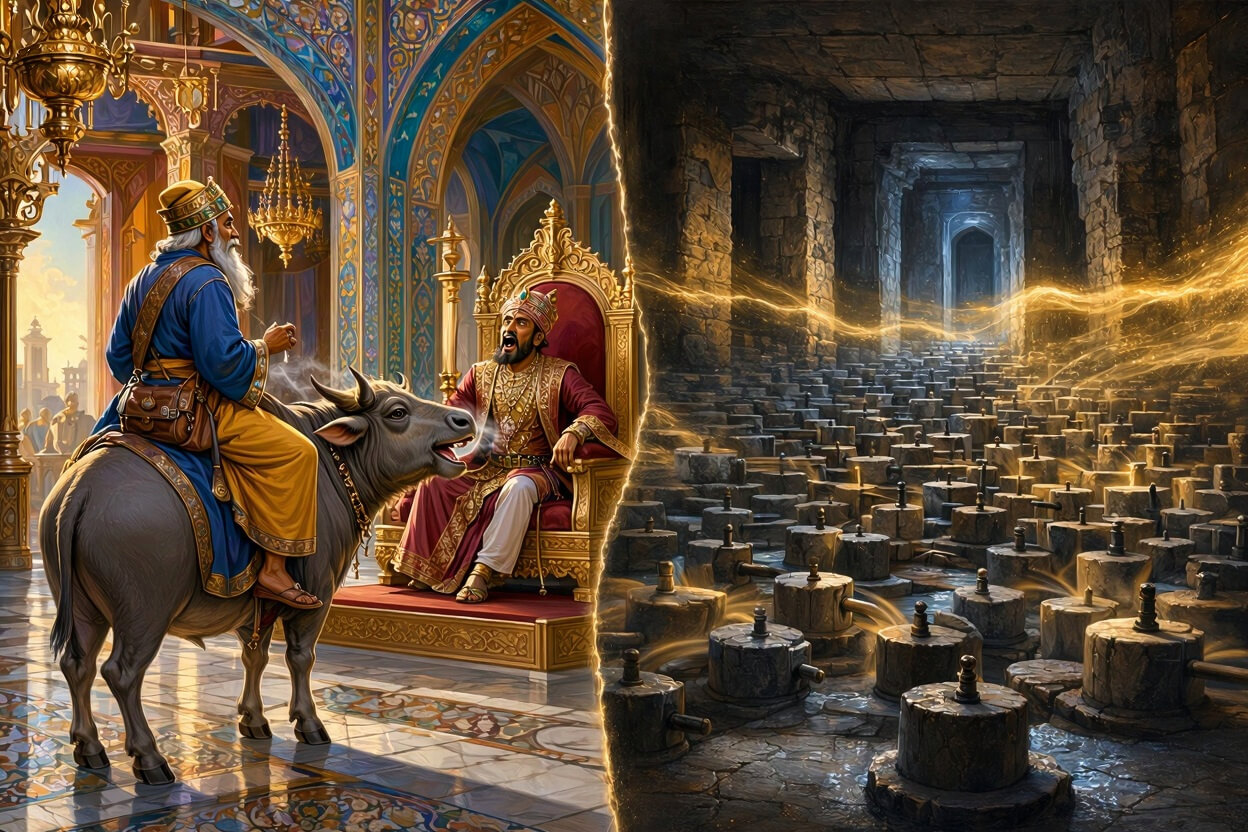
Hearing the anguished cries of the innocent mystics suffering in the dungeons, and seeking to rescue the wandering soul of his supreme devotee, Samman, from the intricate trap of Kaal, Supreme God Kabir mounted a buffalo and rode directly into the royal court of Sultan Ibrahim.
Beholding the Almighty in the humble guise of a wandering sage, Sultan Ibrahim demanded, “Why have you come to my court?” The Supreme Lord replied calmly, “I have come to answer the very question that haunts your mind.”
Ibrahim challenged Him, saying, “Then tell me: what is the true nature of God? If you have truly met the Almighty, introduce me to Him this instant.”
Instead of answering directly, Kabir Ji turned to the beast beneath Him and commanded, “O Buffalo! Tell this monarch what Allah is truly like, and where He resides. Swear by the Heavens and speak the absolute truth.”
To the utter bewilderment of the entire court, the buffalo began to speak in a clear, human voice, declaring, “O Ibrahim! Behold, the Almighty Lord, Allahu Akbar Himself, is the very one sitting upon my back!”
The Sultan was profoundly astounded and shaken by the talking beast, yet his cynical mind resisted the truth. He rationalized it to himself, thinking, “This man must be a master of black magic or a powerful sorcerer.” Before the court could react, the Supreme Lord instantly vanished into thin air along with the buffalo. Overwhelmed by shock, Sultan Ibrahim fainted where he stood.
A moment later, God manifested outside the city gates, standing directly in front of the royal prison. Following the Sultan’s strict standing orders to arrest any holy man on sight, the royal guards seized the Lord and cast Him into the dungeon.
The soldiers crudely ordered the new prisoner to begin grinding flour on the heavy stone hand-mills, alongside the hundreds of weeping sages who were already laboring under the whip. Kabir Ji looked at the guards and proposed a bargain: “We prisoners shall perform one part of the labour, but the guards must perform the other. If we are to turn the heavy stone hand-mills, then you soldiers must continuously pour the grain into them. Alternatively, if we pour the grain, you must do the turning.”
Enraged by the prisoner's audacity, the guards barked, “We will pour the grain! You turn the mills, or face the whip!”
Kabir Ji turned to the captive mystics and commanded, “All holy men, stand up.”
With a gentle tap of His staff against His own hand-mill, a wave of divine energy rippled through the dungeon. Instantly, all three hundred and sixty stone hand-mills began to spin and grind automatically, without a single human hand touching them.
The Lord smiled at the stunned guards and said, “Soldier brothers, begin pouring the grain. Grind as much flour as your kingdom desires.” He then turned back to the trembling sages and instructed, “Close your eyes.”
The mystics obeyed. A split second later, the Lord commanded, “Open your eyes.”
When the sages opened their eyes, the dark, oppressive prison walls were gone. They found themselves standing in the fresh air of a vast forest, leagues away from the city of Balkh. Kabir Ji advised them, “Flee far beyond the borders of this Sultan's kingdom and continue your devotion in peace.” Overwhelmed with profound gratitude, the devotees bowed low, thanking the Supreme Lord before scattering into the safety of the distant lands.
Meanwhile, back at the palace, the Sultan regained consciousness. Troubled by the miracle of the speaking buffalo, he deeply regretted his harshness and resolved to liberate all the imprisoned sages. However, when he hurried down into the depths of the dungeon, he found it completely empty of prisoners. To his absolute amazement, all three hundred and sixty stone hand-mills were still spinning violently on their own, grinding grain into perfect flour. As he stepped closer to inspect them, the miraculous motion suddenly ceased, leaving the mills completely still and leaving the Sultan deeply lost in silent, awe-struck contemplation.
Divine Act 2: The Camel on the Palace Roof
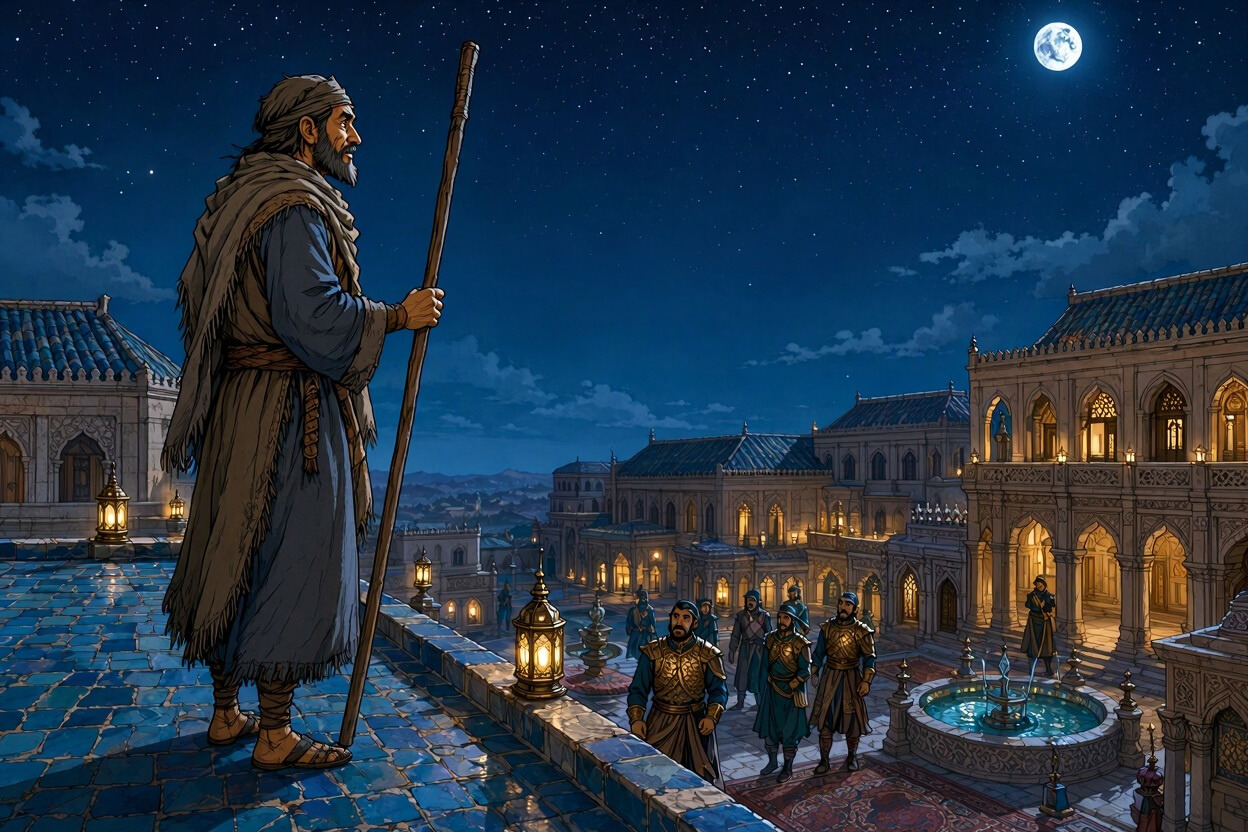
A few weeks passed, but the Sultan's mind remained restless. To further awaken his soul, Supreme God Kabir assumed the disguise of a rustic, nomadic camel herder. Clutching a long wooden staff in His hand, He miraculously appeared on the high terrace of the royal palace dead in the middle of the night.
While Sultan Ibrahim was asleep in his luxurious chambers below, the Lord began striking His heavy staff vigorously against the roof tiles, creating a loud, echoing clatter. Awoken by the disruptive noise, the Sultan sat up in bed and angrily scolded his attendants: “Who dares disturb our sleep? Seize whoever is making this racket and drag them before me at once!”
The royal servants rushed upstairs to the moonlit terrace. There, they captured the mysterious camel herder and brought Him down into the Sultan’s chambers.
Sultan Ibrahim looked at the stranger and demanded, “Who are you, and what business do you have stomping across the roof of my palace in the dead of night?”
The Lord, maintaining His disguise, replied simply, “I am a caravan master, Your Majesty, and I have lost one of my finest camels. I am searching for it up on your roof.”
Sultan Ibrahim laughed in disbelief and scoffed, “O foolish and innocent man! How could a massive camel ever climb onto the roof of a palace? Such a thing is impossible. Go search for your beast out in the wilderness and the forests where it belongs!”
The Supreme Lord looked directly into the monarch's eyes and delivered a piercing truth: “O Ibrahim! Just as a camel is never found wandering upon a palace roof, and your logic dictates it must be sought in the wilderness; so too is the Almighty Lord never found while sitting upon a golden throne and indulging in royal luxuries. If you truly wish to find God, you must seek Him in the company of true saints.”
The moment those profound words were spoken, God Kabir instantly vanished from the locked room. The shock of the divine encounter hit Sultan Ibrahim so intensely that he collapsed unconscious onto the marble floor.
Terrified by the King’s deteriorating state, the royal ministers and queens hurriedly summoned a famous court exorcist. After chanting various incantations, the mystic tied a protective amulet around the Sultan's right arm, proclaiming, “The King is merely possessed by the shadow of malevolent djinns and ghosts; this charm will restore his mind.”
But no amulet could heal the Sultan's soul. From that night forward, Ibrahim lost all interest in the governance, wealth, and grand affairs of his kingdom, spending his days consumed by a deep, melancholic sadness.
- The above account is also mentioned in Masnavi of Rumi. See below.
Masnavi
Once that noble Ibrahim, as he sat on his throne, Heard a clamour and noise of cries on the roof, Also heavy footsteps on the roof of his palace. He said to himself, "Whose heavy feet are those?" He shouted from his window, "Who goes there? 'Tis no man's step; surely 'tis a fairy." His guards, filled with confusion, bowed their heads, Saying, "It is we who are going the rounds in search."
- He said, "What seek ye?" They said "Our camels"
- He said, "Who ever searched for camels on a housetop?"
- They said, "We follow thy example,
- Who seekest union with God while sitting on a throne."
This was all, and no man ever saw him again.
Despite his deep melancholy, the Sultan's lingering bitterness soon led him to imprison yet another group of wandering ascetics. Once again, Supreme God Kabir descended into the dark dungeons to liberate the captive souls.
This time, the Lord turned to the weeping prisoners and commanded, “Stand up, clear your minds, and close your eyes. Lose yourselves in divine meditation upon Allah for a moment. Only then shall we turn the heavy stone hand-mills, and they will spin effortlessly.”
The captive mystics immediately stood up, closing their eyes to focus their hearts entirely on the Almighty. With a gentle tap of His staff against a single stone mill, the divine energy surged through the chamber once more. Instantly, every hand-mill in the dungeon began to spin automatically, grinding the grain with miraculous ease.
God Kabir Ji then called out, “Open your eyes.”
When the sages opened their eyes, the dark dungeon walls had dissolved. They found themselves standing under the open sky of a vast forest, far beyond the city limits of Balkh. The Lord gave them a final warning: “Journey onward, and do not cross back into the borders of this Sultan's kingdom.”
Following this second unexplainable mass escape, the terrified Sultan permanently halted his persecution of holy men. However, out of sheer fear of his wrath, a spiritual vacuum was created—no ascetics, sages, or Mahatmas dared to enter his realms.
This outcome was precisely what Supreme God Kabir had intended. By creating an atmosphere that kept holy men away, the Lord ensured that hypocritical and fake gurus could not enter the kingdom to mislead the vulnerable Sultan or drive him off the path of true salvation. Yet, as the months passed without any spiritual encounters, the memory of the miracles slowly faded from the monarch's mind. The Sultan gradually returned to his normal routine, once more becoming deeply engrossed in the intoxicating comforts and luxurious lifestyle of his throne.
Divine Act 3: The Palace as an Inn
To break the Sultan's lingering attachment to his worldly kingdom, Supreme God Kabir descended once more to perform a profound divine play. Disguised as a weary, simple traveler from the countryside, carrying a bundle of clothes tucked under His arm, the Lord arrived at the royal palace gates at twilight. At that moment, Sultan Ibrahim was sitting comfortably on a chair in the entrance courtyard of his grand residence.
Approaching the throne, the traveler was questioned by the monarch: “Why have you come here?”
God Kabir replied humbly, “I am a weary traveler, brother. I seek shelter at your inn for the night. Tell me, what is the fare for a single night’s stay? How much do you charge your guests?”
Sultan Ibrahim burst into laughter and scoffed, “O innocent traveler, you are deeply mistaken. This is no public inn (Sarai). This is my royal palace, and I am the Emperor of this entire realm!”
Bandi Chhod Almighty God, the boundless ocean of ultimate mercy, looked up at the towering palace walls and asked quietly, “Tell me, then - who resided in this grand palace before you?”
Sultan Ibrahim replied proudly, “My father, my grandfather, and our royal ancestors lived here before me.”
The Lord looked at him and asked, “And where are they now? I wish to meet them.”
“They have all passed away. They are dead,” the Sultan answered.
God Kabir then posed a final, piercing question: “And you, Sultan? For how many days do you intend to reside in this palace?”
Instead of offering a swift reply, the Sultan paused. The weight of the question sank deep into his heart. After a long moment of contemplation, he whispered, “I, too, must eventually face death and leave it behind.”
The Supreme Lord smiled gently and delivered the ultimate spiritual awakening: “O innocent soul! If your ancestors lived here temporarily and died, and if you too must eventually abandon this place to the grave, then tell me—how is this magnificent palace anything other than a temporary inn?”
Tere baap-daada pad peedhee | ve basey isee saraay mein geedhi ||
Aise hi too chal jaai | taatein Ham mahal saraay bataai ||
Ab too takht baithkar bhooli | tera man chadhney ko sooli ||
Translation:
Your father, grandfather, and generations of your ancestors settled in this very inn, completely infatuated by its temporary shelter. Just like them, you too will vanish from this earth; that is why I call your palace a mere inn. Seduced by sitting upon this golden throne, you have forgotten your true purpose, while your mind climbs the very gallows of spiritual destruction.
The moment the final line of the verse echoed through the courtyard, the Supreme Lord instantly vanished from sight. Stripped of his royal illusions, the shock overwhelmed the Sultan, and he fainted onto the stone floor.
It was a long time before the palace attendants could revive their monarch. Deeply alarmed by this recurring affliction, the court officials summoned a different Muslim cleric. After performing various rites of exorcism and whispering incantations, the cleric tied a thick protective amulet around the King’s left arm, confidently proclaiming to the frantic queens, “Do not fear, Your Majesties. The malevolent spirit has been cast out. Nothing further will harm him now.”
Divine Act 4: The Maid in the Naulakha Garden
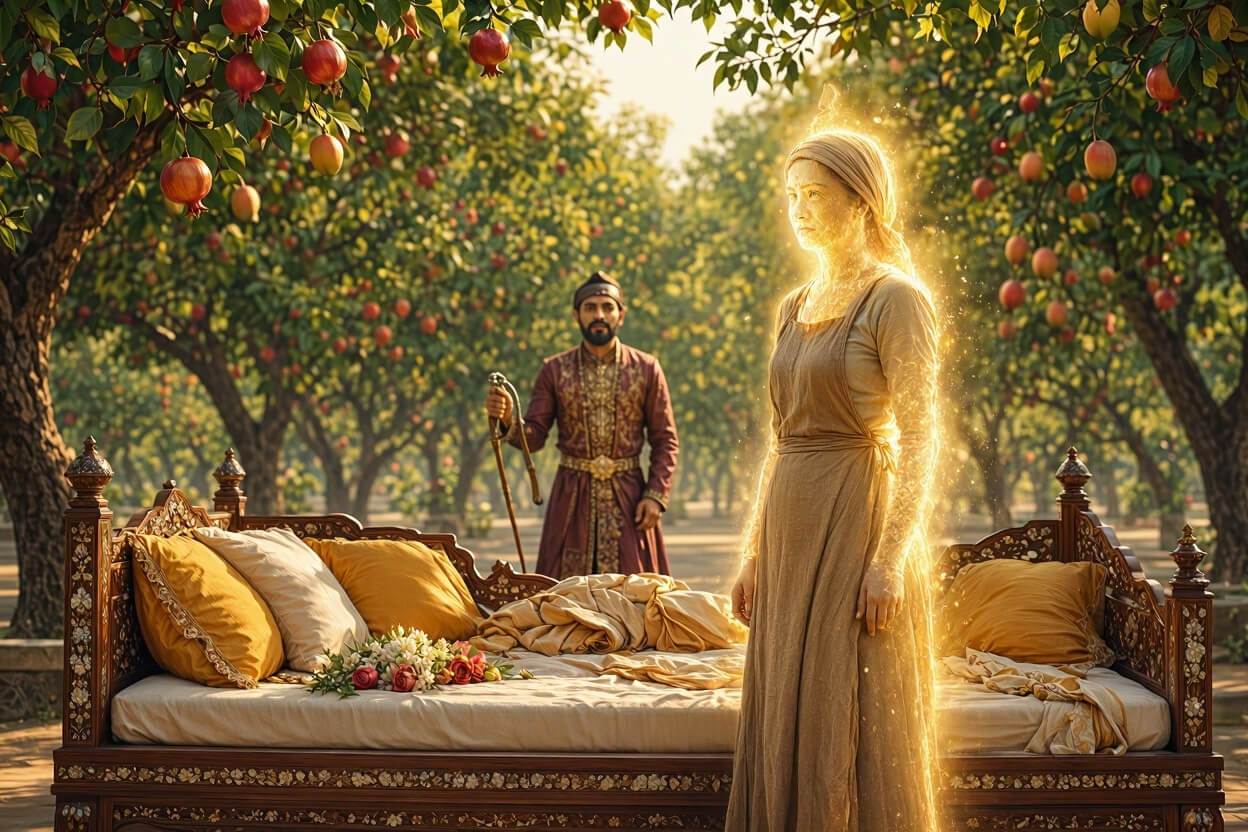
Despite the profound encounters, the sensory distractions of the material world soon pulled the Sultan back to his regular habits, and he once more began indulging in his material pastimes. During the heat of the day, King Ibrahim was accustomed to resting in his magnificent Naulakha Bagh - a vast royal orchard sprawling with nine hundred thousand exotic, fruit-bearing trees.
Each afternoon, a fleet of royal maids dressed in identical uniforms would meticulously prepare his grand garden bed, surrounding it with fresh, fragrant bouquets of blossoms.
Knowing the immense depth of worldly illusion that bound his beloved devotee, the merciful Lord of the poor, Supreme God Kabir, was prepared to deploy every measure necessary to sever Samman’s soul from the formidable traps of Kaal. One afternoon, the Almighty assumed a female form, perfectly disguising Himself as one of the palace maids. Entering the orchard, the Lord arranged the King’s bedding with unmatched beauty, placing the floral bouquets flawlessly before lying down upon the royal cushions Himself.
When Sultan Ibrahim walked into the clearing, he was stunned to see a common servant soundly sleeping upon his personal couch. Angered by her complete lack of fear, the Sultan instantly raised his heavy leather scourge and lashed the disguised Lord three times across the back. The force of the strikes tore the skin, leaving three deep, bleeding welts.
Almighty God, acting out the role of the maid, stepped down from the bed. He wept briefly to mimic human agony, but then suddenly burst into a roaring, joyful laughter.
The Sultan was entirely dumbfounded. By all accounts of physical trauma, the woman should have either passed out from agony or perished from the shock. Grabbing the laughing attendant by the wrist, the bewildered King demanded, “Tell me, maid! What madness possesses you to laugh so loudly after being brutally beaten?”
The Lord looked directly into the monarch's eyes and delivered a chilling realization: “O Ibrahim, I am laughing because I only rested upon this royal bed for a single ghadi - scarcely twenty-four minutes. For that brief moment of comfort, I have been punished with three excruciating lashes that have torn the very skin from my body. I laugh because I am gripped by a profound pity for you, innocent soul. If this is my fate for a few moments of rest, what terrible retribution awaits the one who slumbers day and night upon this dirty bed of worldly illusion?”
Main ek ghadi sej par soee | taatey mera yeh haal hoee||
Jo sovae divas aur raata | unka kya haal vidhaata ||
Gaib bhaye khvaasa | Sultaani bhaye udaasa ||
Yeh kaun chhalaava bhaai | yaaka bhed samajh na aai ||
Translation:
For resting upon this royal couch for a mere single hour, look at the brutal state I have been reduced to. What terrifying fate must the Creator hold in store for the one who sleeps upon it day and night? With these words, the attendant vanished into thin air, leaving the Sultan struck by a deep, agonizing melancholy. "What strange, divine illusion is this, brother?" he wept, "I cannot fathom its mystery."
As the final words echoed through the garden, the majestic form vanished instantly from the Sultan's grasp. Overwhelmed by the crushing weight of the spiritual truth, Sultan Ibrahim collapsed unconscious onto the grass. When he finally awoke under the darkening sky, his heart was heavy with confusion. “What is happening to my reality?” he pondered in deep despair, “I can no longer comprehend the world around me.”
Divine Act 5: The Jinda Fakir and the Three Dogs

Deeply concerned by the Sultan's growing withdrawal, his queens and royal ministers devised a plan. “Take the King on an extended hunting expedition,” they suggested. “A few days spent in the deep forest will divert his mind and lift his heavy melancholy.”
The royal court set out, but the hunt yielded nothing. By noon on the first day, not a single beast had been sighted, frustrating the high-strung monarch. “The forests are usually teeming with herds of deer,” the Sultan grumbled. “Yet today, the wilderness is utterly barren.”
Suddenly, a lone deer bounded into the clearing. Desperate for a catch, the Sultan commanded his men: “This deer must not escape! Whoever lets it pass uncaught shall answer to me with their life.”
As if to mock his royal authority, the deer leaped straight beneath the belly of the Sultan's own horse and dashed deep into the thicket. Overcome with embarrassment and fury, Ibrahim spurred his mount into a frantic chase. He rode swiftly for miles until the deer vanished completely into the dense forest.
Lost and isolated, both the King and his exhausted horse were gripped by an agonizing thirst. Parched under the baking sun, they were on the very brink of collapse. Fearing for his life, the proud King humbled himself and wept, praying to Allah for water. Though his camp lay only an hour's ride away, he knew neither he nor his horse would survive the journey back.
Struggling onward through the brush, Ibrahim suddenly spotted a miraculous sight. Sitting quietly in a small clearing was an ancient Jinda Fakir. Beside the holy man flowed a pristine reservoir of cool, fresh water, surrounded by a lush orchard of trees heavily bowed with sweet, ripe fruits.
Seizing this ray of life, the Sultan drank deeply from the pool, gathered fruit to sustain himself, and led his horse to drink before tethering the beast to a nearby tree.
As he turned his attention back to the mystic, he noticed something bizarre: the Jinda Baba held three remarkably beautiful dogs on a leash. Coiled on the grass beside them lay a heavy, empty iron tethering chain.
The Sultan offered the traditional greeting: “Salaam Alaykum.”
The fakir looked up, responding calmly, “Alaykum Salaam.”
Intrigued by the fine animals, the King said, “O Fakir, what use does a wandering ascetic have for three such magnificent dogs? Grant me a favor and give two of them to me.”
The fakir shook his head and replied sternly, “I cannot give these creatures to anyone. I am here to teach them a harsh, necessary lesson. You see, in their immediate past lives, these three were once the powerful Emperors of this very city of Balkh. When they walked the earth in human form, I repeatedly admonished them, warning: ‘Remember Allah. You will not dwell in this material world forever. If you die without devotion, you will descend into the wretched life of a street dog.’
In those days, they feasted on rich naan, savory pulao, cashews, raisins, sweet rice pudding, and halwa. Those luxuries were merely the temporal rewards of a few good deeds performed in their distant past. But because they refused to worship God during their precious human lives, they are now condemned to suffer the low existence of animals. Soon, they will not have this fine food; they will be reduced to eating refuse and drinking foul water from the city drains.”
The Jinda Baba continued, his voice echoing through the trees: “When they sat upon their golden thrones, they dismissed my warnings, thinking, ‘This fakir is a foolish madman! If we abandon our pursuits to worship, who will govern our grand kingdom? What will become of our queens?’ Now, look at their plight. I place bowls of rich rice pudding and sweet halwa laden with almonds and cashews directly before their noses - but I do not allow them a single bite. I merely show them what they have lost. The moment they reach for it, I discipline them.”
Saying this, the Lord picked up the heavy, cold iron chain and began striking the dogs. The animals howled and whimpered in agony.
“Now eat your halwa!” the Lord cried out to the beasts. “Let me feed you the stale scraps you truly deserve!”
Turning his piercing gaze directly upon the trembling monarch, the fakir asked, “O horse rider, do you wish to know what this idle iron chain beside me is for? The current ruler of Balkh is Sultan Ibrahim ibn Adham. Blinded by the fleeting glare of his material kingdom and royal crown, he too has entirely forgotten his Creator, Allah. He passes his days completely unaware that he, too, is sprinting toward the birth of a dog. I have warned him multiple times to remember that his palace is a mere inn, yet he harbors no fear of the Divine. Instead, he plays the role of God himself, cruelly punishing innocent fakirs in his prisons. I sit here in the deep wilderness, so I am safe from his reach. But that King will eventually face his death. Having abandoned true worship, his soul will be cast into the form of a dog - and I shall personally drag his spirit here and bind him with this very chain.”
Hearing these terrifying words from the mouth of the mystic, and looking upon the weeping forms of his own royal ancestors trapped in the bodies of beasts, a violent tremor shook Sultan Ibrahim's entire frame. Realizing the absolute truth of his destiny, he collapsed into the dirt, weeping bitterly.
“O Holy One!” he cried out, “I am that very man - I am Ibrahim, the King of Balkh! Forgive my arrogance, I beg of you!”
The Sultan threw himself prostrate, burying his face at the fakir's feet. For several long minutes, he lay there in total surrender. When he finally raised his tear-stained face, the entire landscape had transformed. There was no Jinda Baba, no lush orchard, no cool reservoir, and no dogs.
For a fleeting second, the Sultan tried to convince himself that it was a mere hallucination born of exhaustion. But as he stood up, he looked down at his horse - its hooves were still visibly soaked with fresh water from the vanished pool. In his own hands, he still held the sweet fruits he had plucked from the non-existent trees.
The reality of the divine warning settled heavily into his soul. Ibrahim mounted his horse and rode back to the royal hunting camp in absolute silence. Unable to utter a single word to his court, he simply gestured with a sharp wave of his hand to break camp and return to the city. Within minutes, the royal caravan departed the forest, racing back to the gates of Balkh.
Divine Act 6: The Wounded Dog's Warning
Retreating to his private chambers deep within the palace, the Sultan sat in isolation and wept bitterly. Distressed by his intense grief, the queens and ministers gathered around his couch, trying desperately to console him. The chief queens pleaded, “Your Majesty, such emotional outbursts are expected from delicate women, but you are a king! You must have courage. You are the guardian and protector of this entire empire.”
Just as they finished speaking, a wretched dog stumbled directly into the royal chambers. The animal bore a horrific, gaping wound upon its head, which was heavily infested with writhing maggots.
To the absolute horror of the royal court, the creature opened its mouth and spoke in a clear, agonized voice: “O Sultan Ibrahim! In my immediate past life, I too was a mighty king ruling over a grand empire. Today, every innocent animal I brutally slaughtered during my hunting expeditions, and every soldier I causelessly sent to their death in battle, are claiming their ultimate karmic revenge. They have been reborn as these maggots inside my skull, slowly devouring my flesh. I am utterly powerless to stop them. If you do not awaken, you are destined to face this exact same wretched plight. Behold your own certain future! The Supreme Lord Himself is wandering behind you, seeking to save you, yet you continue to destroy your eternal soul for the fleeting attachments of family and a material kingdom.”
This terrifying divine play was the final, compassionate blow delivered by Supreme God Kabir. It was the precise shock needed to shatter Ibrahim’s illusions and pull his soul completely out of the suffocating swamp of worldly attachments.
That very night, as the palace fell into a deep silence, Sultan Ibrahim made his ultimate choice. He discarded his royal robes, veiled his features to conceal his identity, and wrapped a simple shawl around himself in place of an alfi - the traditional sleeveless garb of a wandering fakir. Gathering nothing but a pillow, a humble metal water pot, and a thin mattress for bedding, the monarch slipped out to the rear of the fortress.
Securing a kamand - a thick, knotted escape rope traditionally reserved for fleeing a castle in times of extreme peril - he climbed down from the towering stone walls and stepped onto the dark earth below. Without a single glance backward, the Emperor of Balkh turned his back on his throne forever and set off into the night to seek true salvation.
Divine Act 7: The Lesson of the Relinquished Shoes
As dawn broke over the horizon, Sultan Ibrahim found himself exhausted and famished after walking through the entire night. Near the outskirts of a vast orchard, he encountered a maalin (female gardener) selling fresh Ber (jujube fruits). When he asked her the price, she informed him that a single ser (kilogram) of fruit cost one anna—a minor fraction of a rupee.
Though Ibrahim did not possess a single coin, he was still wearing his royal, emerald-encrusted footwear, which was worth a staggering two and a half lakh rupees.
Desperate with hunger, Ibrahim offered them to her: “I carry no coins upon me, but I have these shoes worth a fortune. Take them both. I ask only that you weigh out a single kilogram of fruit to sustain me.”
Stunned by the trade, the woman weighed the fruit and leaned forward to tip it into Ibrahim's outstretched shawl. In the process, a single loose berry slipped and tumbled onto the dirt. Driven by a lingering, desperate impulse of worldly possessiveness, Ibrahim lunged to snatch the fallen berry at the exact same moment the gardener reached for it. Both began to aggressively argue over the solitary fruit.
In that very instant, Supreme God Kabir manifested before them. Looking at the two, the Lord delivered a sharp, awakening rebuke: “O simpleton of a woman! You are a fool who lacks the basic discretion to see that you are quarrelling over a single berry with a man who just handed you shoes worth a fortune. And you, Ibrahim! What an utterly foolish ascetic you are! You have walked away from a kingdom and relinquished shoes worth lakhs, yet here you are bickering in the dirt over a single berry worth less than a penny! What kind of true renunciation is this? Act with spiritual prudence!”
With these piercing words, the Lord struck the Sultan across the face with a swift slap of awakening and instantly vanished.
Shaken to his core, Ibrahim realized that true detachment is a gradual restructuring of the mind. As he journeyed further down the road, he observed a penniless laborer sleeping soundly on the hard earth, resting his head comfortably upon a heavy earthen clod. Realizing his own lingering dependence on comfort, Ibrahim immediately cast away his own pillow and mattress. A mile later, he witnessed a traveler drinking cool water straight from a rushing river using nothing but his cupped hands. Smiling at the simplicity of nature, Ibrahim threw down his metal water pot as well, stripping his worldly possessions down to nothing.
Admonishing the Souls Trapped in the Maze of Kaal
As he walked onward, the sky darkened and a cold, biting rain began to fall. Seeking shelter from the freezing winds, Ibrahim huddled behind the wall of a small mud hut. The modest dwelling belonged to a poor local farmer who owned a mere two bighas of dry, unirrigated land, a single aging cow, and a one-eyed wife.
Huddled in the dark, Ibrahim couldn't help but overhear the couple talking inside. “The heavens have truly blessed us with this rain,” the husband said cheerfully. “Our small plot will yield a fine harvest, and there will be abundant green fodder for our cow. Truly, we enjoy a life of peace and comfort that even the mighty Sultan of Balkh-Bukhara could never know!”
Hearing this, Ibrahim shook his head in disbelief, thinking the impoverished couple had entirely lost their senses to compare their meager existence to a royal empire. He resolved to stay behind their hut until sunrise, determined to open their eyes to the inevitable sorrows of the material world.
When the sun rose, the farmer and his wife stepped outside, only to find the ragged ascetic standing at their doorway. After greeting them respectfully, Ibrahim began preaching to them about the urgent need to worship the Almighty and reject the illusions of Maya (material wealth).
“You possess but a single cow, a humble wife, and two small fragments of land,” Ibrahim urged them. “Yet you cling to these fleeting things so fiercely, falsely believing your lifestyle is grander than that of the Emperor of Balkh! Do you not see that this worldly existence is a mere country fair that will vanish in a few days? Let me introduce you to my Guru Ji so you may receive true spiritual initiation and bless your souls. I myself am Sultan Ibrahim Adham of Balkh; I willingly abdicated my entire empire to seek the living God!”
The farmer and his wife looked at the ragged traveler, entirely unimpressed. They burst into mocking laughter and retorted, “We do not believe for a second that you were ever the King of Balkh. But if by some miracle you speak the truth, then there is surely no greater fool walking this earth than you! Keep your grand sermons to yourself - we have no need for your teachings.”
Sultan said that :-
Garib, raandi (wife) dhaandi (cow) na tajaen, ye nar kahiye kaag |
Balakh Bukhaara tyaag diya, thi koee pichhli laag ||
The Ascent to the Throne of Devotion
From that momentous dawn onward, Ibrahim Adham ceased to be a sultan of the material earth and instead ascended as a magnificent sultan of true devotion - the king of absolute devotees. It is for this reason that historical accounts and spiritual circles affectionately refer to him simply as Sultan or Sultani.
This transition mirrors other great mystics, such as Dharmdas Ji, who became known as Dhani Dharmdas because he was immensely wealthy in the currency of divine worship, alongside his worldly assets. Upon their profound meeting, Supreme God Kabir granted Sultan Ibrahim his first spiritual mantra (Pratham Naam), promising: “In due time, I shall bless you with Satnaam, and ultimately, the sacred Saar Shabd.”
Evidence from the Kabir Sagar
This systematic path of initiation is explicitly documented on page 62 of the chapter titled "Sultan Bodh" within the holy scripture Kabir Sagar:
Pratham paan pravaana leyi | peechhe saar shabd toee deyi ||
Tab Satguru ne alakh lakhaaya | kari parteet param pad paaya ||
Sahaj chauka kar deenha paana | kaal ka bandhan tod bagaana ||
Contextual Meaning:
The seeker is first accepted through the initial token of faith and the first mantra (Pratham Naam), after which the ultimate Saar Shabd is revealed. It is then that the Satguru makes the unseen, Supreme Divine visible. Upon anchoring one's absolute faith, the soul attains the ultimate spiritual state. Through a simple, unpretentious Chauka (sacred initiation setting), the divine mantra is given, completely shattering the heavy bonds of Kaal and setting the soul free.
This verse clarifies an important truth: at that hour of renunciation, Ibrahim possessed absolutely no material wealth or elaborate facilities to conduct a complex, expensive Aarti Chauka. This reveals the true, unadulterated method of initiation practiced by Almighty Kabir. True initiation does not demand thousands of rupees, grand offerings, or elaborate materials like coconuts. While a formal scriptural reading (Paath) may be conducted by a devotee later in life if resources allow, the core initiation requires nothing more than sanctified water (Chanted Water) and a humble sweet substance, such as rock sugar or jaggery. When granting the higher stages of Satnaam and Saar Shabd, no physical liquid or token is given; instead, the deep, transformative meditation mantras are directly transmitted and explained to the soul.
The Testimony of Sant Garib Das Ji
Centuries later, Supreme God Kabir descended to meet the revered mystic Sant Garibdas Ji in the village of Chhudani (District Jhajjar, Haryana), granting him profound divine vision. Based on that firsthand cosmic revelation, Sant Garibdas Ji recorded the supreme identity of the Creator and His historical interventions across various lifetimes:
Garib, Ham Sultaani Nanak taarey, Dadu koon updesh diya |
Jaati julaaha bhed na paaya, Kaashi maahen Kabir hua ||
Translation:
Garib Das proclaims the words of the Almighty: "It was I who liberated Sultani (Ibrahim Adham) and Guru Nanak Dev, and it was I who delivered the true spiritual instruction to Dadu Dayal. Appearing in the historic city of Kashi as a humble weaver (Julaha), the blind world could never fathom My hidden divine secret."
Garib, anant koti brahmaand ka, ek rati nahin bhaar |
Satguru Purush Kabir hain, kul ke sirjanhaar ||
Translation:
Garib Das declares that the one who effortlessly sustains infinite millions of universes without feeling the weight of a single atom is none other than the Supreme Lord, Satguru Purush Kabir - the ultimate Creator of all existence.
Spiritual Teachings by Sant Garib Das Ji
Supreme God Kabir told his disciple Garibdas ji that: -
Sunat gyaan galtaana pad padein samaana ||tek||
Amar lok se Satguru aaye, roop dharaa karvaana |
Dhoondhat oont mahal par dolaen, boojhat Shaah byaana ||tek||
Ham kaarvaan hoy aaye | mahlaun par oont bataaye ||1||
Bole paadshaah Sultaana | too rehta kahaan divaana ||2||
Doojae kaasid gavan kiya re | dera mahal saraay liya re ||3||
Jab Ham mahal saraay bataai | Sultaani koon taanvar aai ||4||
Arey tere baap daada pad peedhi | ye basey saraay mein geedi ||5||
Aise hi too chali jaai | yaun Ham mahal saraay bataai ||6||
Arey koyi kaasid koon gahi lyaavae | is pandit khaaney dyaavae ||7||
Oothey paadshaah Sultaana | vahaan kaasid gaeb chhipaana ||8||
Teeje baandi hoy sej bichhaai | tan teen koradey khaai ||9||
Tab aaya anhad haansa | Sultaani gahey khavaasa ||10||
Main ek ghadi sejaan soyi | taataen mera yauh havaal hoyi ||11||
Jo sovaen divas ru raata | tin ka kya haal vidhaata ||12||
Tab gaibi bhaye khavaasa | Sultaani huye udaasa ||13||
Yauh kaun chhalaava bhaai | yaaka kachhu bhed na paai ||14||
Chauthey yogi bhaye Ham Jinda | leenhein teen kuttey gali fanda ||15||
Deenhi Ham saankal daari | Sultaani chaley baag baadi ||16||
Boley paatshaah Sultaana | kahaan se aaye Jind divaana ||17||
Ye teen kuttey kya keeje | inmein se doy ham koon deeje ||18||
Arey tere baap daada hain bhaai | in badh badfael kamaai ||19||
Yahaan loh langar sheesh lagaai | tab kutyaun dhoom machaai ||20||
Arey tere baap daada padh peedhi | toon samjhe kyoon nahin geedi ||21||
Ab tum takht baithkar bhooli | tera man chadhne koon shooli ||22||
Yogi Jinda gaeb bhayaa re | ham naa kachhu bhed lahya re ||23||
Boley paadshaah Sultaana | jahaan khadey ameer divaana ||24||
Yeh chyaar charitr beetey | ham na kachhu bhed na leetey ||25||
Vahaan Ham maarya gyaan gilola | Sultaani mukh nahin bola ||26||
Tab lagey gyaan ke baanaa | chhaadi begam maal khajaana ||27||
Sultaani yog liya re | Satguru updesh diya re ||28||
Chhaadya athaara laakh tura re | jis laagae maal bura re ||29||
Chaadey gaj gaenvar jal hoda | ab bhaye baat ke roda ||30||
Sang solah sahans suheli | ek se ek adhik naveli ||31||
Garib, athaarah laakh tura jin chhodey, padyamani solah sahans |
Ek palak mein tyaag gaye, so Satguru ke hain hans ||32||
Raandi-dhaandi na tajaen, ye nar kahiye kaag |
Balakh Bukhaara tyaag diya, thee koyi pichhli laag ||33||
Chhaadey meer khaan divaana, arabon kharab khajaana ||34||
Chhaadey heerey hirambar laala | Sultaani motey taala || 35 ||
Jin lok parganaa tyaaga | suni shabd anaahad laagya ||36||
Pagdi ki kaupeen banaai | shaalaun ki alfi laai ||37||
Sheesh kiya munh kaara | Sultaani tajya Bukhaara ||38||
Gan Gandharv Indr larjey | dhanya maat pita jin sirje ||39||
Bhayaa saptpuri par saaka | Sultaani maarg baanka ||40||
Jin paanchaun pakdi pachhaadya | inka to de diya baada ||41||
Sunn shabd anaahad raata | jahaan Kaal karm nahin jaata ||42||
Nahin kachh machh kurambha | jahaan dhaul dharni nahin thamba ||43||
Nahin chandr soor jahaan taara | nahin dhaul dharni gainaara ||44||
Nahin Shesh Mahesh Ganesha | nahin Gaura Shaarad bhesha ||45||
Jahaan Brahma Vishnu na vaani | nahin Naarad Shaard jaani ||46||
Jahaan nahin Ravan nahin Rama | nahin Maya ka vishraama ||47||
Jahaan Parsuram nahin parcha | nahin Bali Baavan ki charcha ||48||
Nahin Kans Kaanh kartaara | nahin gopi gvaal pasaara ||49||
Yauh aavan jaan bakheda | yahaan kaun basaavae khera ||50||
Jahaan nau dasma nahin bhaai | dooje koon thaahar naahin ||51||
Jahaan nahin aachaar vichaara | koyi shaalig poojanhaara ||52||
Ved Quran na pandit qaaji | jahaan Kaal karm nahin baaji ||53||
Nahin Hindu Musalmaana | kuchh Ram na duva salaama ||54||
Jahaan paati paan na pooja | koyi dev nahin hai dooja ||55||
Jahaan deval dhaam na dehi | cheenhyo kyun naa shabd sanehi ||56||
Nahin pind praan jahaan shwaasa | nahin mer kumer kailaasha ||57||
Nahin Satyayug Dwaapar Treta | kahoon Kaliyug kaaran ketaa ||58||
Yauh to anjan gyaan safaa re | dekho deedaar nafaa re ||59||
NiHbeej sat niranjan loyi | jal thal mein ramta soyi ||60||
Hai nirbhay nirgun beena | soyi shabd ateetam cheenha ||61||
Adol abol anaatha | nahin dekhya aavat jaata ||62||
Hai agam anaahad sindha | yogi nirgun nirbandha ||63||
Kachhu vaar paar nahin thaaham | Satguru sab shaahanpati Shaaham ||64||
Ulti panth khoj hai meena | Satguru Kabir bhed kahaen beena ||65||
Yauh sindhu athaah anoopam | kachhu na chhaaya na dhoopam ||66||
Jahaan gagan dhuni darbaani | jahaan baaje satya sahidaani ||67||
Sultaan Adham jahaan raata | tahaan nahin paanch tatt kaa gaata ||68||
Jahaan nirgun noor divaala | kachhu na ghar hai khaala ||69||
Sheesh chadhaay pag dhariya | yauh Sultaani sauda kariya ||70||
Satguru Jinda yog diya re | Sultaani apna kiya re ||71||
Kahae Daas Garib Guru poora | Satguru miley Kabira ||72||
{This is the meaning of these above speeches of Sant Garibdas ji. In these also, the events of the life of Sultan Ibrahim ibn Adham have been described.}
The Tests of Ibrahim Adham's Devotion
Sultan Adham saw the hut of a sage who had been doing spiritual practice at that place for many years. Ibrahim went to him. That worshipper said, “Do not stay here; there is no food or water here. Go somewhere else.” Sultan Ibrahim said, “I have not come here as your guest. He, whose guest (guest of Allah) I am, will arrange for my (rizq) food. A human being brings his destiny with him. Nobody eats food of anybody. O dishonest! You are not even a good citizen. You want to meet Allah. If the intention is not right, a person cannot do acts of charity. Without charity, God is not found. He, who has given life, will also give bread.” Ibrahim sat down at a distance.
The Test of the Sky Plate and Plain Food
In the evening, a plate descended from the sky containing different types of vegetable dishes, halwa, rice pudding, roti (bread) and a pot of water. The plate was covered with a handkerchief. Ibrahim lifted the cloth from the plate and showed it to the old worshipper. A plate descended from the sky for the old worshipper with two rotis that too of barley flour and a pot of water.
Seeing this, the old worshipper was disgruntled and said, “O Allah! I will not eat the food sent by you. You discriminate. You have sent me dry barley roti, and a good food with pilau to Ibrahim.”
Allah spoke through an ether voice, “O Devotee! This Ibrahim was an affluent king. He had billions and trillions in his treasury. He had 16 thousand queens, had children, ministers and diwans. He had servants and maids. He has renounced those luxuries for me. Whatever I give him would be less. Look at your status. You were a grass cutter. You used to dig grass all day, then you used to earn a taka (currency). Every day, you used to carry the burden of bundles on your head. You had neither a (Bibi) wife, nor mother, nor a father who was a merchant. I send you cooked rotis. You still throw tantrums. If you are not happy in my will, then go and sit somewhere else. If you feel disinclined to do bhakti (worship), then here is your trowel to dig the grass and the net to tie it, go, dig the grass and earn your daily bread. If you want to achieve something, do not step outside my will. If a devotee has kubra (arrogance), then he is far from God. If a devotee is submissive, then he is close to Hakk (God).”
Sultan Adham appealed to God, “O Benefactor! I will make a living by working hard. I will worship you too. Please do not send this food. I want to remain at your feet by eating plain and dry food. My mind will become corrupt by eating this food that you are sending; I will make some mistake.” Even that old devotee was listening to this prayer. He hung his head in shame. He [the old devotee] prayed to God, “Lord! Pardon my mistake. I will remain happy in your will.” From that day on, Ibrahim would fetch the wood from the forest, and get food after selling it in the market. He used to eat the same food for eight days and worship.
The Honest Guard of the Pomegranate Garden
After a few years, Ibrahim went on a tour. There was a merchant who owned a garden. He needed a servant. He employed Sultan to guard the garden. After a year, the merchant came to the garden. He asked Ibrahim to bring pomegranate. Ibrahim brought pomegranates and gave them to the merchant. The pomegranates were sour. The merchant said, “You have not even found out in a year what sweet pomegranates are like?”
Sultan said, “Seth ji! You have kept me to protect the garden, not to destroy the garden. If the protector becomes the eater, then how will things work out? I have never eaten any fruit, so how can I have the knowledge of sweet and sour?” When the Seth asked other servants, the servants told him, “This servant only eats the bread that he gets, and then keeps walking around the garden while mumbling something. We have even watched him secretly. He has never plucked any fruit and eaten it, nor has he picked up any fruit lying on the ground.”
Some servant told the merchant, “He is the king of Balakh city. I saw him 10 years ago while hunting in the forest. When I asked him that you seem to be Sultan Ibrahim Adham of Balakh city, then initially, he denied. Then I told him, “I saw you in the forest while hunting. My brother-in-law, Yakub, is a senior officer in your army. He told me that the king has taken sanyas (renunciation). His son is sitting on the throne.” Then he said, “Please do not tell anyone.” The merchant fell at Sultan’s feet and asked for forgiveness, and giving him a lot of money, said, “Kindly take this money and sustain yourself; worship as well. Feel free to stay at my house or I shall build a palace for you in the garden; stay here and worship.” Sultan thanked him and departed from there.
Defining the True Sentiment of a Slave (Das)
Once, Sultan went to the ashram of a saint, and stayed there for a few days at the special request of the saint. The saint's name was Hukam Das. Twelve disciples lived with him in the ashram. Everyone had the word ‘Das’ appended to their names. Fakir Das, Anand Das, Karm Das, Dharmdas. Their behaviour was not that of a Das (slave). If their guru asked one of them for some service, he would say that it is Dharmdas's turn; ask him. Dharm Das would say, “It is Anand Das' turn.” Seeing their behaviour, Sultani said that: -
Dasa bhaav nedae nahin, naam dharaaya daas |
Paani ke peeye bin, kaise mit hai pyaas ||
Sultani explained to those disciples, “When I was a king, I had bought a slave.” I asked him, “What do you like to eat?” The slave replied, “The food that the master gives to the slave is his choice.” I asked, “What do you wish? What do you like to do?” He said, “Whatever the master commands, that is my choice.” I asked, “What do you wear?” He replied, “I wear the worn-out clothes given by the master after repairing them.” I freed him. I gave him money too. Remembering his words, I follow the orders of my Guru. I never exercise my volition. I eat what God gives, considering it His command. I serve considering myself a slave. It is mandatory to please Gurudev to please God.” After that, all those disciples started following the orders of their Guru ji with the sentiment of them being slaves, and they started behaving well among themselves. They made their life successful.
How Ibrahim Adham Obtained Saarnaam
God Kabir started living by building an ashram. He was popularly known as Jinda Baba. After a few months of granting the first mantra to Sultani, he was initiated into Satnaam (two-word mantra), in which one is the mantra "Om" and the other is told at the time of the initiation. Sultan visited many times to obtain an (darshan) auspicious sight of his Gurudev. After Satyanaam, Saar Shabd is given to a worshipper in initiation when he becomes eligible for it. After a year, Sultan Adham went to his guru's hut and made a humble request for initiation of Saarnaam. Supreme God said, "Come after a year on exactly the same day, I will give you Saarnaam. You can come anytime (for darshan) to behold and meet me.” A year later, when Sultan Ibrahim Adham went to Guruji's hut on the very same day to get the Saarnaam, Guru Ji said, “Come after exactly one year on this day, I will give the Saarnaam.” Eleven (11) years passed in doing this. He also used to come every now and then to obtain a sight of the Satguru, but for Saarnaam, he had to come only on a fixed day. When in the eleventh year, Sultani was coming for the initiation of Saarshabd, he was passing through a street next to a house. The lady of that house swept the garbage off the roof and threw it in the street; it accidentally fell on the devotee. When the garbage fell on Sultan Ibrahim, he shouted, “Can you not see? People also walk up and down the street. If I had not renounced the kingdom, I would have flayed you today.”
That sister apologised and said, O Brother! It is my mistake; I should have first looked in the street. I will take care in future.” That sister, who owned that house, was also a devotee of Jinda Baba. When she saw Ibrahim in the ashram, she asked Guruji, “O Gurudev! The devotee, who is sitting in solitude, was he ever a king?” Jinda Baba asked, “What is the matter, daughter? Here, there is no difference between a king and a commoner. Why did you ask this question? He was earlier the king of Balakh city. When I explained this knowledge to him, he renounced the kingdom. Now he works hard and makes a living by selling wood, and he also does worship.” The sister told, “While I was throwing dry garbage from the roof, accidentally some fell on him, so he was infuriated and said, “If I had not renounced the kingdom, I would have stripped your skin off.” After the spiritual discourse, those eligible for Saar Shabd were called. When Sultan Ibrahim's turn came, Guru ji said, “You are still a king. Child! Saar Shabd is given to a slave, who has accepted the body as dirt.” Sultani said, “Gurudev! It has been years since I renounced the kingdom.” Guru Maharaj Ji said, “Nothing is hidden from me; I know the way you have renounced the kingdom. You have not relinquished the sentiment of regality. Come on this very day after a year for Saarnaam.” Sultani was coming again after a year. He had to pass by the same house. Guru ji told the same female disciple, “Tomorrow that king will come to take Saarshabd. The way to the hut is next to your house. There is no other way to reach the hut. This time, fill a bucket with cow dung and ash dissolved in water, and pour it over him. Then tell me what his reaction is.” That sister did the same. At the same time, the sister also said, “O brother! It fell by mistake. I will wash your clothes and clean them. You can take a bath in the pond here.” Sultan said, “Sister, dirt has fallen on dirt; it does not matter. I shall take a bath and wash my clothes.” That female disciple told Sultani’s reaction to Gurudev. Then Guru ji gave him the Saarshabd, and said, “Son! Today you have become a slave. Now your salvation is certain.”
Therefore, devotees should learn lessons from this story. Do not be in a hurry to obtain the Saarshabd. Normalize all the vices within you. Act prudently; salvation is certain.
A King is Big or a King of Devotees
Once, Sultan Adham went and sat by a pond outside his Balakh city. His son was the king. When he learned about it, he mounted an elephant and reached the pond with a musical procession. He asked his father to return home. Sultan flatly refused. His son said, “Look, what you have done to yourself. Live comfortably here. You are suffering as a beggar. Everything happens today by my orders.” Sultan said, “What God can do, a king cannot.” His son said, “I will do whatever you order me to do. You will have to stay with us.” Sultani said, “Alright; I accept it. I am putting a sewing needle with my hand in this pond. Take this needle out of the water and return it to me.” The king summoned the soldiers, divers and net throwers. They tried everything, but all in vain. His son said, “Father! I will get you a thousand needles in lieu of one needle. Will your Allah take this needle out of the water?” Then Sultan said, “O Son! Will you do bhakti if my Allah takes the same needle out of the water? Will you take sanyas (renounce the kingdom)?” His son said, “You may first get this needle taken out of the water by your lord, then I will think.” Ibrahim said, “O daughters of God, fish! A needle of this humble servant has fallen in your pond. Please take my needle out and give it to me.” Within a few moments, a fish came to the shore near Ibrahim with a needle in its mouth. Ibrahim grabbed the needle and thanked the fish with folded hands. Then Sultani said, “Son! Look, a human being, even if he is a king, cannot do what God can do. Will you worship God now?” His son said, “God has only given you a needle; I can give you diamonds and pearls. I will worship God in my old age.” Devotee Ibrahim got up and departed. He went into his cave.
Disorders like Lust, Attachment, Anger, Desire are not Destroyed; They are Pacified
Vikaar marey na jaaniyo, jyon bhoobhal mein aag |
Jab karellae dhadhkahee, Satguru sharna laag ||
Once, Ibrahim Sultan was visiting the city of Mecca. His purpose behind going there was to preach to the misled Muslim devotees who visit Mecca for Hajj or otherwise as well. He stayed there for a few days to instruct them. He also made a few disciples. A Hajj traveller went to the city of Balakh and told that Sultan Ibrahim lives in Mecca. Ibrahim’s little boy insisted on seeing his father, so his mother, the little boy along with some men and women of the city went to Mecca and met Ibrahim. Ibrahim used to preach to his disciples that one should not gaze at a boy without a beard and a moustache, and another woman. By doing so, one becomes infatuated with them. Seeing his son, Ibrahim could not hold back; he kept staring at the child. The boy was about 13 years old. The disciples said, “Gurudev, you preach to us that one should not look for a long time at a child without a beard and moustache, and you are yourself staring at him.” Ibrahim said, “I do not know why I am getting attracted towards him.” At the same time, an old man said, “O King! This is your (Begum) wife and this is your son. He was in his mother’s womb, when you renounced the kingdom. They have come to meet you.” Immediately, the boy after touching the feet of his father, sat on his lap. Tears of affection welled up in Ibrahim's eyes.
There was an ethervoice from God that – “O Sultani! You do not love me anymore. You love your family. Go to your home.” Instantaneously, Ibrahim was shocked. He closed his eyes and prayed, “O God! It is beyond my control, either kill me or this boy.” At that very moment, the boy died. Ibrahim got up and left. The people from Balakh started preparing for the last rites of the boy. To attain God, a devotee has to fulfill every criterion. Then one becomes successful. God immediately gave human life to that boy's soul and gave him birth in the house of His devotee. From childhood, that soul got the path of God.
Once, all the devotees gathered in the ashram of Baba Jinda for a satsang. That boy was 4 years old at the time. By the grace of God, his bed and Ibrahim's bed were placed side by side. Seeing Ibrahim, the boy said, “Father! Why did you leave me in Mecca? I am now born in the house of a devotee. Look, Allah has reunited me with you.” When this matter went to Guru Ji Jinda Baba (Supreme God Kabir Ji), Jinda Baba told that this is Ibrahim’s son who had died in Mecca. Now God has given birth to this soul in the house of a devotee.” Ibrahim was deeply saddened by the death of the boy, but he did not share it with anyone. That day he said, “O Ocean of Mercy! You are Omniscient. I feel relieved today. It kept coming to my mind again and again that, “Why did God do this? With what face will his mother go home? Today my soul is completely at peace.” Jinda Baba sent a message to that woman, the former mother of that boy i.e., Ibrahim's wife that she should come to the ashram. He also summoned that boy, his new parents and Ibrahim. He introduced the boy to his former mother. As soon as the boy saw her, he said, “O Mother! You left me in Mecca and went away. Allah came there. Look, he is sitting here (he spoke while pointing to Jinda Baba). He took me with him and left at these people’s house. I went into this mother's stomach. Then I was born. Now I have taken initiation. I chant the first mantra. O Mother! You too should take initiation from Guru ji. You will be emancipated.” Ibrahim's wife took initiation and said, “Send this boy with me.”
Supreme God Kabir (Jinda Baba) said, “If he had to be kept in that hell (in the glare of the kingdom), why would he have died? Now you should come to the ashram and meet the child once in a month in the satsang.” Ibrahim did not feel the sense of belonging in that boy, because he was born from someone else's body. But Ibrahim’s delusion, the foolishness of his mind, was destroyed. Which he used to say in his mind that Allah should not have done it. Now he realised that whatever God does, he does good. Even if it does not feel good at that time. All living beings belong to Allah; He thinks of the welfare of all. We think of our own interests. Even the queen did not have the same feeling in that boy, but the soul was the same. Therefore, mother's affection was still alive in her heart. So, she used to feel peaceful on seeing him. Making this a reason, God emancipated both the queen and the child.
A Devotee’s Nature is Like That of a (Tarvar) Tree
Once a merchant was travelling for business by a ship. He was also accompanied by a group of those who prepared food during the journey and who entertained everyone with jokes and mockery. It was a long journey. It had to take a month. The pranksters needed a person at whom they could direct all their derision. On searching, they found Ibrahim. They caught him and took him with them. They thought that this beggar needs bread; he will get it. After going far in the sea, an entertainment programme began for the merchant. They were making fun of Ibrahim. They were saying, “There was a fool like this (Ibrahim) man. He was sitting on the same branch of the tree that he was cutting. He fell and died.” They laughed out loudly. In this way, they kept making such indecent comments for a long time.
Ibrahim was very sad. He thought, “I will have to bear this for months. I will neither be able to worship, nor will I be able to live in peace.” At that very moment, an ethervoice occurred, “O Devotee Ibrahim! If you say, then I will kill these fools. I will sink the ship; I will save you. They bother you.” Hearing this voice from the sky, all the people of the ship got frightened. Ibrahim said, “O Allah! Do not put this stigma on my forehead. They are ignorant. Instead of killing so many people, kill me or give them good sense; they should get the welfare of their souls done by worshipping you.” All the passengers including the ship owner apologised to Ibrahim and listened to the knowledge of God. They kept him respectfully with them. He was given a separate place in the ship to worship. Ibrahim, after explaining the true knowledge to all of them, brought them to the ashram and got them initiated from Guru ji.
Ibrahim himself used to give initiation. When someone told Jinda Baba i.e., Supreme God Kabir in the presence of Ibrahim that “O Gurudev! Ibrahim gives initiation”, then God told Ibrahim, “O devotee! You are making a mistake. You are not authorised.” After that day, Ibrahim stopped giving initiation, and he got all his disciples initiated again from Guru ji. He begged for forgiveness. He himself also got his naam purified (reconnected). He did not make such mistake in future.
Historical Witnesses of Almighty Kabir
Question: Where is the proof that Allah Kabir was performing the divine acts in the form of Al-Khijr? Weaver Kabir (of Kashi, India) is himself (Kaadir) Almighty Allah who has created everything.
Answer: - First, let me prove that the weaver named Kabir, who used to live in Kashi (Banaras) city, is the God who created the entire universe. For this, there are several eyewitnesses who saw that (Kaadir) Almighty Allah sitting on the (Takht) throne above and told that Kabir, who used to play the role of a weaver in the city of Kashi (India country), is Himself the Almighty God.
Witness 1: Sant Garibdas Ji
Sant Garibdas ji, a ten-year-old boy, along with other cowherds of the village had gone to his fields to graze cows as usual. In Vikrami Samvat 1784 (1727 C.E.), on the (Shudi Dwadashi) twelfth day of the bright fortnight of the Falgun month (mid-February to mid-March), around ten o'clock in the day, the cowherds and the boy Garibdas ji were eating food while sitting in the shade of a Jandi tree (Jandi is the name of a tree which belongs to the species of acacia). Supreme God in the guise of Jinda Baba (Al-Khijr) travelled from the throne above in the sky and descended on earth at some distance and went to the cowherds. That Jandi tree was on the unpaved road leading from village-Kablana to village-Chhudani and was in the field of Sant Garibdas ji, adjacent to the border of Kablana. {Sant Garibdas’ father had one thousand three hundred seventy-five (1375) acres of land in the village. A pasture was made on the same land in which other poor people of village Chhudani also took their cows for grazing.} Seeing Jinda Baba, i.e., a sadhu, one of the older cowherds said, “Baba ji, have food.” The sage said, "I have come after eating food at my abode." Several cowherds said in unison, "If you do not eat food, drink milk." God said, “Give me milk, but give milk of that cow who has never given birth, that is, of a virgin cow.” The cowherds considered it a joke.
Boy Garibdas got up and brought one of his dear heifers and said, “O Baba ji! How can this virgin cow give milk?” Baba Ji said, “It will give milk. Bring a clean vessel and put it under its udders.” Sant Garibdas ji took an earthen pot (a small, clean pitcher of 3-4 kg capacity) and while holding it under the udders of the heifer, sat down. Baba Jinda (Al-Khijr) patted the heifer’s back with his hand. Instantly, the udders became longer and somewhat thicker, and milk started coming out. When that vessel of 3-4-kilogram capacity filled up, the milk stopped coming from the udders. Child Garibdas ji gave that pot full of milk to Baba ji and said, “This has been obtained only by your grace; please drink it.” Baba Jinda drank some milk by putting that pot to his lips. He directed the rest towards those cowherds and said, “Drink it; this is Prasaad (blessed).” The other cowherds got up and left. They said, “This milk has been extracted from a virgin calf through sorcery. We will become possessed by ghosts or evil spirits. He seems to be an exorcist (who expels an evil spirit from a person). The milk of a heifer is sinful milk. Who knows which lower caste this Baba belongs to. We will not drink his sipped milk.”
Boy Garibdas ji took the vessel from Baba and drank some milk from it as the cowherds watched. The older cowherds advised the boy not to drink milk. The child did not listen to them. Everyone went far away. Baba Jinda and child Garibdas ji remained. Then Baba Jinda narrated some knowledge. The child expressed a desire to see Satlok and the Almighty God (whom Baba had described to be more powerful than Brahma ji, Vishnu ji and Shiv ji) with his own eyes. Jinda Baba took out the soul of child Garibdas from his body and took it to the sky. He showed the worlds of Brahma ji, Vishnu ji and Shiv ji, showed heaven and hell. He showed Brahmlok (Mahajannat / Great Heaven) of Kaal Brahm. Then he took him further up to his Amarlok (immortal world). The Jinda Baba who had gone with the child sat down on the throne built above. At that time, he acquired the form of God. The brightness of one hair of the body of God was more than the light of crores of suns. Amarlok was illuminated. Child Garibdas ji also acquired a different body whose brightness was equivalent to the light of sixteen suns. All the male and female devotees (hans / hansni) of Amarlok started prostrating themselves before Supreme God. They started chanting "Glory be to Kabir Satpurush!". Everyone said, “This is Almighty God, the Creator of infinite crore brahmands (universes). His name is Kabir.” Then God put all the knowledge in the soul of his Prophet Garibdas ji. After showing the entire Satlok and all the lower worlds, he inserted the soul of the child into his body. At that time, the body of child Garibdas ji was kept on a pyre (pile of wood) for the last rites. When people were about to light the pyre, Garibdas ji got up. A wave of happiness ran through the village. Sant Garibdas ji was initiated by the same Supreme God guised as Jinda Baba. Sant Garibdas ji described the complete spiritual knowledge that he had eye-witnessed as well as heard from the lotus-mouth of the Supreme God, in the form of couplets, quatrains, hymns, which were written down by a Mahatma named Gopal Das who was initiated from the sect of Dadu ji. The writing work took about six months.
The context is that where is the proof that Al-Khijr is Al-Kabir? :- As in this very topic "Information About Al-Khijr (Al-Kabir)" under the heading "Introduction of Rumi", it is written that a person named Rumi was a (maulvi) Muslim cleric in a mosque in the city of Konya in Turkey. He used to propagate the Muslim religion. People used to pay special respect to him. After comprehending the knowledge imparted by Saint Shams Tabrez, he gave up the title of Maulvi and worshipped as instructed by Guru Ji Shams Tabrez. He also become a famous poet. He told that Sultan Ibrahim ibn Adham, (Balkhi) the king of Balakh city, had renounced the kingdom after being inspired by Al-Khijr. He spent the rest of his life in the worship of Allah while staying in contact with Al-Khijr. Sultan used to have the darshan (sight) of Al-Khijr. You have read above the entire episode of Sultan Ibrahim Ibn Adham, in which it is clear that Allah Kabir ji had inspired Sultan to worship. Therefore, Al-Khijr only is Al-Kabir. Sant Garibdas ji has also endorsed this: -
Garib, Ham Sultani Nanak taarey, Dadu koon updesh diya |
Jaati julaaha bhed na paaya, Kaashi maanhi Kabir hua ||
Meaning - Sant Garibdas ji has stated that all of us (I - Garibdas, Sultan Ibrahim ibn Adham, Nanak ji, the founder of Sikh religion, and Sant Dadu ji) were emancipated by that Satguru Supreme God Kabir who belonged to weaver caste in the city of Kashi. Then he has stated :-
Garib, anant koti brahmand ka, ek rati nahin bhaar |
Satguru Purush Kabir hain, kul ke sirjanhaar ||
Meaning - My Satguru, Supreme God Kabir, is the originator of all brahmands (universes), that is, the Creator of entire creation. He created all the worlds, stars, and constellations (sun, moon, planets) and secured them by his power, which in the language of science is called gravitational force. There is no burden of all this creation (infinite crore brahmands) on that Creator Kabir. Like, a scientist made an airplane and flew it. He himself also boarded it. Just as the scientist does not have any burden of that airplane on him; rather, he is sitting on it; similarly, Kabir Almighty Allah, having created all the worlds, is sitting on them and has also made all the living beings sit on them. This proves that Al-Khijr only is Al-Kabir.
Witness 2: Sant Dadu Das Ji
When Sant Dadu Das ji was an eleven-year-old boy, Allah Kabir in the guise of a Jinda Baba met him in the forest outside the village. After taking out the soul of Saint Dadu ji, Al-Kabir ji took him up to his Satlok. Dadu ji remained unconscious for three days and nights. Allah Kabir showed His throne above and introduced himself, “I am Purna Brahm (Supreme God). I have created the whole universe.” After showing all the brahmands (universes) to child Dadu ji, on the third day, Allah Kabir ji put his soul back in his body. Sant Dadu Das ji regained consciousness. Then people asked him, “What had happened to you?” Dadu ji told, “Allah Kabir had met me in the guise of a Baba, and He gave me initiation. He took me to the skies above.” Dadu ji had some other children of the same age with him at the time. They had also told that a Baba had turned water into a magic potion; he himself drank it and making a bowl of a betel leaf, spit that water into it and made Dadu drink it. Then Baba became invisible. Dadu lost consciousness. Sant Garibdas ji has described the knowledge received from Supreme God Kabir in his speech as follows: -
Garib, Dadu koon Satguru miley, deyi paan kee peek |
Boodha Baba jisey kahein, yeh Dadu kee nahin seekh ||
Meaning - Kabir Allah, who was disguised as Jinda Baba, had met Sant Dadu ji in the form of Satguru. He had put rinsed water from his mouth on a betel leaf and made Dadu ji drink it at the time of initiation. The people who say that Dadu had met an old Baba, who was an exorcist; Dadu did not tell this. What Dadu ji has told about this is as follows, which is written in the Dadu Granth composed of the speech uttered by Dadu ji. Speech :-
Jin mokoon nij naam diya, soyi Satguru hamaar |
Dadu doosra koyi nahin, Kabir sirjanhaar ||
Dadu naam Kabir ka, sunkar kaampe kaal |
Naam bharosae jo chaley, hovey naa baanka baal ||
Kehari naam Kabir hai, visham Kaal gajraaj |
Dadu bhajan prataap se, bhaage sunat aavaaj ||
Meaning - Dadu ji has said that the one who gave me the (Nijnaam) correct mantra of worship is my Satguru. His name is Kabir. This same Kabir is the (Creator) Originator of the whole universe (Nature).
Sant Dadu ji has said that Jyoti Niranjan (Kaal) starts trembling on hearing the name "Kabir". The name Kabir is so powerful. Kaal Brahm cannot cause any harm to a devotee who leads his life with full faith in the naam (mantra) given by Kabir ji.
Sant Dadu ji has described the power of Kabir Allah through an example that Kaal is also very powerful, but he also becomes weak in front of Kabir Allah. Kaal is as strong as (Gajraj) the king of elephants. The naam (mantra) given to worship Kabir ji is also very powerful. It is as powerful as Kehri i.e., the biggest lion. If that naam (mantra) is chanted, Kaal cannot stand before the power of that naam(mantra)-like lion, that is, hearing the subtle roar of the naam (lion), Kaal-like (Gajraj) elephant runs away. Sant Dadu Das ji has made it clear that Kabir is the Supreme God who is the Creator of the entire nature (universe).
Witness 3: Saint Dharmdas Ji
Being born in Hindu religion, Dharmdas ji used to perform spiritual practice based on the incomplete knowledge imparted by Hindu religious leaders. Once, while on a pilgrimage as per the guidance of religious leaders, he had gone to Mathura (the city of Shri Krishna). He was carrying idols of gods and goddesses (Shri Vishnu, Shri Shankar and Goddess etc.) made of stone and brass in his bag. In the morning, after bathing in the holy pond (Shri Krishna used to take bath in that pond), he started worshipping the idols. At that time, Kabir Allah was present in the world to play the role of a weaver in the Kashi city of India. He arrived at the same pond in Mathura to show the true path to Dharmdas ji. He was watching Dharmdas ji doing all the actions. After worshipping the idols, Dharmdas ji recited Shrimad Bhagavat Gita. Khuda (God) Kabir was watching and listening carefully to all the actions of Dharmdas ji. When Dharmdas ji finished his daily acts of worship, then God Kabir held a discussion on spiritual knowledge with him. The rounds of discussion of knowledge lasted several days. Allah Kabir also took Dharmdas ji to the throne built in His Satlok. Dharmdas ji remained unconscious for three days. Allah Kabir showed him all the worlds above. He showed His Satlok. After explaining the entire spiritual knowledge, he put him back in his body. After that, Sant Dharmdas ji quit his previous method of worship and performed the true worship preached by Allah Kabir, who had Himself come as His own prophet, and attained complete salvation. Dharmdas ji uttered many speeches in the glory of Allah Kabir: -
Aaj mohe darshan diyo ji Kabir ||
Amarlok se chalkar aaye, kaatan jam ki janjeer |
Hindu ke tum dev kahaaye, musalmaan ke peer |
Dono deen ka jhagda chhid gaya, toha naa paaya shareer ||
Dharmdas ki arj gunsaai, kheva langhaaiyo parle teer ||
Meaning - Dharmdas ji, after seeing Satlok, accepted that Kabir, the weaver of Kashi, is the (Kaadir) Almighty Allah, the Creator of the whole universe. He gave a detailed eye-witnessed description of His magnificence.
When Supreme God Kabir physically (along with His body) went to Satlok from Maghar town of Gorakhpur district of Uttar Pradesh state of India, at that time, Hindu King Bir Singh, who was the king of Kashi city, and Muslim Nawab Bijli Khan Pathan, who was the Nawab of Maghar town, both were his disciples. Many Hindus and Muslims, who are said to be sixty-four lakhs in number, from Maghar, Kashi and many other places were also disciples of Kabir ji. When Kabir Ji mentioned about going to Satlok, then the people of both the religions (Hindu and Muslim) and the kings, insisting that the last rites be performed in their own way, became ready to fight. Then Kabir ji said to them, “Do not fight after I am gone. I will lay one sheet under me and one over me. Divide my body into two parts and take one sheet and half of the body each. I will abandon the one who fights.” A sheet was laid. Devotees reverently spread fragrant flowers two to three inches thick on it. Kabir ji lay on top of them. He covered himself with a sheet. The people of both the religions had malicious thoughts in their minds; they were thinking, “Last rites of half a body is bad omen; therefore, we will acquire the whole body by fighting and then we will perform the last rites.” Allah Kabir even knows our thoughts. After some time, a voice came from the sky, “Lift the sheet and see, there is no dead body under it.” When everyone looked up, they saw Kabir ji was going upwards in the sky. He was saying, “I am Supreme God Kabir, the (Kartaar) Creator of the whole universe. You could not understand me.” When they lifted the sheet, there was a pile of fragrant flowers equivalent to the size of a dead body. (Khuda) God Kabir had mounted His throne in the sky. If God had not performed that miracle, there would have been a fierce battle between the Hindus and the Muslims. Thousands of people would have been killed. No one could avert that disaster except God. At that very moment, Hindus and Muslims hugged each other and wept bitterly in the grief of Allah's departure. They said, “We did not recognise Allah. We have made a big mistake.” One sheet and half of the flowers were given to each of the religion. Bijli Khan Pathan (Nawab of Maghar), for his Pir Kabir Ji, gave space to both the religions to perform the last rites of the flowers at one place (within a distance of hundred feet). Both the religions performed the last rites of a sheet and half of the flowers according to their respective custom. Even today both the memorials are present in Maghar town (District - Sant Kabir Nagar, Uttar Pradesh, India). Bijli Khan Pathan had (zakat) donated 500 bighas of land each for both the memorials.
PICTURE OF MAGHAR MEMORIAL
When Supreme God Kabir left from the midst of everyone, then Sant Dharmdas ji cried in his separation and said, “O Supreme God Kabir! Please visit me again. You had travelled from your throne in Satlok and come to earth to sever the chain of the bondage of our deeds. A fight was about to break between the two (deen) religions. Everyone had prepared their respective armies to fight with weapons. Your body was not found. You are Almighty Allah. This divine act is sufficient to understand this. O Supreme God! Convey the (kheva) boat of my life across to (parle teer) the other side of the world-like river, that is, grant me salvation. After some days, Allah Kabir ji came from Satlok and again met Sant Dharmdas ji. He stayed with him. He sent Sant Dharmdas ji to Satlok. This proves that the one who had met Hazrat Muhammad Sallam in the form of Al-Khijr, that Al-Kabir alone is the Creator of the universe.
Witness 4: Sant Malook Das Ji
Kabir ji also took Sant Malook Das ji to Satlok. After showing all the arrangement, He left him back in his body. Earlier Malook Das ji was a supreme devotee of Shri Krishna and Shri Ramchandra (Shri Vishnu ji). After that, relinquishing the previous worship, he performed the method of worship preached by Khuda (God) Kabir. He attained salvation. Sant Malook Das said: -
Japo re man Saaheb naam Kabir, japo re man Parmeshwar naam Kabir ||
Ek samay Guru bansi bajaai, kaalandri ke teer |
Sur nar munijan thakat bhaye, ruk gaya jamna neer ||
Amrit bhojan mhaare Satguru jeemein, shabd doodh ki kheer |
Daas Malook salook kahat hai, khojo Khasam Kabir ||
Meaning - Sant Malook Das ji has clarified that chant the naam (mantra) of God Kabir. Search for that (Khasam) Master of all, Kabir; recognise Him. After performing true worship, go to God Kabir in Satlok. As has been stated about Shri Krishna that he used to play melodious flute. Hearing its tune, the female cowherds and the cows used to get attracted to him. Malook Das has told that once my Satguru Kabir ji played the flute on the banks of the river Jamna (Kaalandri), on hearing which the gods of heaven, sages and people of nearby villages were drawn to Him. And what can I say? Even the water of the Jamna River came to a halt. My Satguru eats the kheer (pudding) of the Shabd (word), that is, along with nectar food, he also enjoys eternal bliss. Sant Malook Das ji gave an eye-witnessed account that Kabir is Complete God (Purna Brahm / Kaadir Allah / Almighty God).
Witness 5: Guru Nanak Dev Ji
God had met Shri Nanak Ji when Shri Nanak Dev Saheb Ji used to work in the storehouse of Nawab in Sultanpur city. Bein river flows half a kilometer away from Sultanpur city. Shri Nanak ji used to go daily to bathe in that river.
One day, God appeared on the Bein river in the attire of Jinda Baba. There He had a discussion with Shri Nanak Dev Ji on spiritual knowledge. After that, Shri Nanak ji took a dip in the river, but he did not come out. The people present there assumed that Nanak ji had drowned in the river. The people of the city also searched by putting a net in the river but were disappointed because Shri Nanak Dev ji had gone to Sachkhand (Satlok) with the Supreme God who had appeared in the form of Jinda Baba. After three days, Shri Nanak Dev Ji returned to Earth. He stood on the same spot on the bank of the Bein river from where he had disappeared. The joy of the residents of Sultanpur knew no bounds on seeing Shri Nanak ji alive. Shri Nanak's sister Nanaki was also married in Sultanpur city. Shri Nanak ji used to live with his sister. Sister Nanaki, who was saddened by the grief of her brother's death, was astonished and the grief turned into joy. Shri Nanak Dev met God; he got the true knowledge and the true naam (Satyanam). In both the books, Bhai Bale Wali "Janm Sakhi Guru Nanak Dev Ji" and in Praan Sangli in Hindi script, whose editor is Sant Sampoorn Singh, there is evidence that Sri Guru Nanak Dev Ji himself told Mardana, “I met God in the form of Jinda Baba on the Bein river, when I went to take a bath. I had stayed with Him for three days. That Jinda Baba is my Satguru as well as the Creator of the universe. Therefore, only He is entitled to be called "Baba"; others should not be called "Baba". His name is Kabir.”
Kaayam Daayam Kudarti Sab Peeran Sir Peer Aalam Badaa Kabir |
Therefore, Shri Nanak ji's speech (Mehla 1) matches with the Sukshmved. It is correct. The speech of other saints is not so accurate. The reason is that Shri Nanak Dev Ji had met God Kabir Ji.
Evidence: - The speech written in Sri Guru Granth Sahib on page 24: -
Ek suan duyi suaani naal bhalke bhonkahi sadaa biaal,
Kudh chhura mutha murdaar Dhaanak roop rahaa Kartaar |
Tera ek naam taare sansaar main eho aash eho aadhar,
Dhaanak roop rahaa Kartaar |
Faahi surat malooki vesh, eh thagwaada thagi desh |
kharaa siyaana, bahuta bhaar, Dhaanak roop rahaa Kartaar ||
The following speech is written in Shri Guru Granth Sahib Ji, on Page 731: -
Neech jaati pardeshi mera, kshan aavae kshan jaavae |
Jaaki sangat Nanak rahanda, kyukar munda paavae ||
On page 721, the following speech is written: -
Yak arj guftam pesh todar, koon Kartaar |
Hakka Kabir Kareem Tu Beyaeb Parvardigaar ||
This above-mentioned sacred speech is from Shri Guru Granth Sahib ji, which proved that God had met Shri Nanak ji. He is "Kabir Kartaar" (Kabir, the Creator) who had come to Kashi to perform a divine act in the form of a Dhaanak (weaver).
It is clear from the above pieces of evidence that Kabir, the weaver from Kashi (India), is the Creator of all; He is the Almighty God who sustains and nurtures everyone. He alone, in the form of Al-Khijr, had met good souls. By disguising in other such forms, He also makes the righteous souls aware of the best method of worship. It is also clear from the above topic of Sultan Ibrahim ibn Adham that Al-Khijr only is Kabir Allah.
