The Hidden Hierarchy of the Puranas: Parentage of Brahma, Vishnu, and Shiva
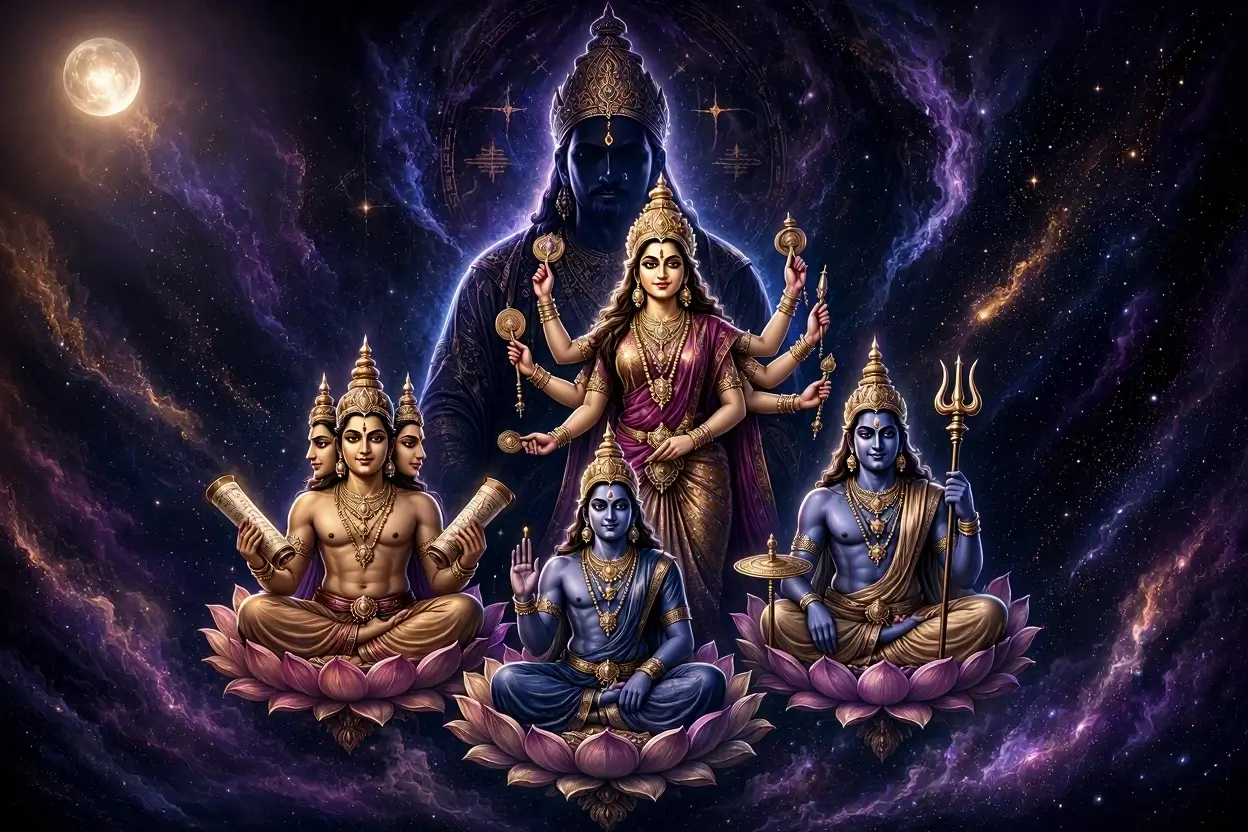
Clarifying the Lineage of the Trimurti and the Macro-Forms of God Kaal - A deep reading of the primary Hindu scriptures - specifically the Shiv Purana, Vishnu Purana, and Shrimad Devi Bhagwat Purana - often leaves the average seeker completely confused. If you read the Vishnu Purana, it sings the ultimate glory of Lord Vishnu. If you turn to the Shiv Purana, Lord Shiva is described as the supreme, uncreated power. Meanwhile, the Devi Bhagwat Purana establishes the Divine Mother as the source of everything.
How can all three claims be true? Who is the ultimate authority, and more importantly, who is the father of Brahma, Vishnu, and Shiva? This article resolves this long-standing cosmic mystery by mapping out the precise metaphysical lineage hidden within the text of the Mahapuranas. By understanding the distinction between the macrocosmic "Maha" forms and the microcosmic "Trimurti" sons, the apparent contradictions of the scriptures completely vanish.
The Root Cause of Confusion & God Kaal
The confusion exists because most readers treat the Puranas as isolated text blocks rather than an interconnected web of cosmic governance. When traditional translators encounter verses describing a supreme creator named Vishnu or Shiva, they conflate that supreme entity with the localized deities ruling over our immediate world. To clear this confusion, we must introduce the true architect of the material realm: God Kaal (also known as Brahm or Jyoti Niranjan).
God Kaal is the primary entity and ruler of the 21 material universes. He is not the Supreme God of the spiritual sky (Satlok), but he is the absolute governor of the physical, material creation.
Because Kaal remains hidden from physical sight (as stated in Shrimad Bhagavad Gita Chapter 11, where he reveals his terrifying, unmanifest Kaal-form), he does not govern his vast realm directly in his true appearance. Instead, he projects his energy into three grand, macrocosmic forms to manage the primary forces of nature:
- Maha-Brahma: The macro-form of Kaal acting as the ultimate reservoir of creative force.
- Maha-Vishnu: The macro-form of Kaal acting as the ultimate reservoir of sustaining force.
- Maha-Shiva (Sadashiv): The macro-form of Kaal acting as the ultimate reservoir of destructive force.
When the Vishnu Purana sings the glory of "Mahavishnu", or the Shiv Purana praises "Sadashiv", the scriptures are actually referring to these macrocosmic expansions of God Kaal.
Parental Lineage of the Trimurti
The physical deities we know as the Trimurti - Brahma, Vishnu, and Shiva - are not uncreated, self-manifested beings. They are the literal, biological children of God Kaal and Goddess Durga (also called Ashtangi or Prakriti).
| Deity / Form | Scriptural Mother | Scriptural Father | Cosmic Quality (Guna) |
|---|---|---|---|
| Lord Brahma | Goddess Durga (Ashtangi) | God Kaal (Jyoti Niranjan) | Rajoguna (Creation) |
| Lord Vishnu | Goddess Durga (Ashtangi) | God Kaal (Jyoti Niranjan) | Satoguna (Preservation) |
| Lord Shiva | Goddess Durga (Ashtangi) | God Kaal (Jyoti Niranjan) | Tamoguna (Destruction) |
The Roles and Residences of the Sons
Upon their birth, their father (Kaal) and mother (Durga) assigned these three brothers their specific microcosmic duties and separated them into individual visual zones (Loks) within the material universe:
- Brahma was given the quality of Rajoguna (activity/passion) to oversee the generation of physical bodies.
- Vishnu was given the quality of Satoguna (purity/goodness) to sustain and maintain life.
- Shiva was given the quality of Tamoguna (darkness/dissolution) to handle the destruction of physical matter.
Structural Evidence from the Puranas
This hierarchy is not a modern theory; it is explicitly detailed in the authoritative editions of the Puranas (such as those published by Gita Press, Gorakhpur):
1. Evidence from Shrimad Devi Bhagwat Purana (Skand 3)
In the third Skand of this text, Lord Lakshmi’s husband, Vishnu, explicitly confesses his mortality and parentage. He states directly to the Divine Mother:
I (Vishnu), Brahma, and Shiva are bound to birth and death. We possess a beginning and an end. We are not eternal. We manifest by your grace, and our father is Brahm (Kaal).
2. Evidence from Shiv Purana
The Shiv Purana explicitly outlines the birth of the three deities from the union of Sadashiv (Kaal) and Pradhan (Durga). It records how the three brothers were placed into deep meditation, unaware of their father's hidden form, and given their distinct duties to manage the cosmos.
The Reality of Mortality: Why the Trinity is Not Supreme
Because Brahma, Vishnu, and Shiva are born from a mother and father, they are bound by the physics of the material universe. They possess incredibly long lifespans measured in cosmic cycles (Chaturyugis), but their lives are finite.
As documented in the cosmic time scales of the Devi Bhagwat Purana, the deities possess incredibly long lifespans measured in cosmic cycles (Chaturyugis), but their lives remain finite. For a full scriptural timeline, view our complete breakdown of the Age of Lord Brahma.
- The age of Lord Brahma is set at 100 Divine Years (equivalent to 311 trillion, 40 billion earth years).
- The age of Lord Vishnu is exactly seven times the lifespan of Brahma (2 quadrillion, 177 trillion, 280 billion earth years).
- The age of Lord Shiva is exactly three times the lifespan of Vishnu.
When their time expires, the three brothers pass away, and new souls are elevated to take over their cosmic offices during the next cycle of creation. A being subject to aging, birth, and death cannot be the ultimate savior of humanity.
Conclusion: Resolving the Contradiction
The mystery is solved once you separate the Macro from the Micro:
The texts are accurate when they state that Mahavishnu or Sadashiv governs the universe. However, those names belong to the hidden ruler, God Kaal. The localized Trinity of Brahma, Vishnu, and Shiva are his mortal sons, tasked with running the day-to-day mechanisms of our physical world.
True spiritual liberation (Moksha) cannot be achieved by worshiping the governors of a temporary material prison. Real salvation requires looking past the 21 universes of Kaal, past his macrocosmic forms, and directing one's devotion toward the true, uncreated, immortal Supreme Being who exists far beyond this cyclical realm.
